
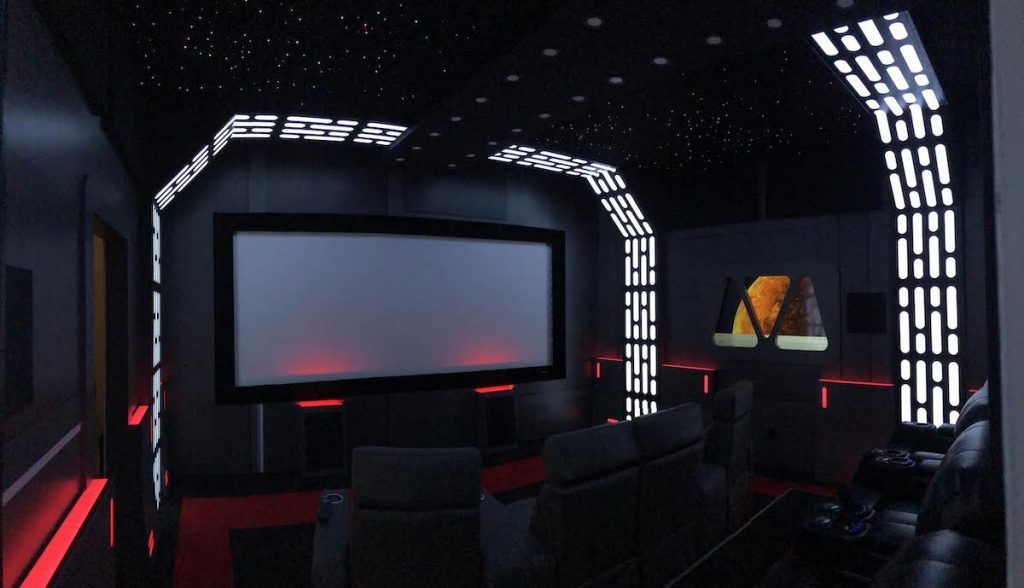
One of the first major projects that the team at Encompass had ever been involved in was the Star Wars themed movie theatre for our client, OneTouch House.
A talented, Victoria based company, OneTouch House has been growing rapidly over the last five years. The introduction of high-quality home automation products, as well as the increasing popularity of the "smart home", has positioned OneTouch House well to become the leaders in home and business automation on Vancouver Island. Because of this, in 2018 they expanded to a new showroom twice the size of their existing space.
The new showroom was to become more of an experience centre; a place where they could bring customers to showcase the various products and automation solutions they had to offer. They wanted the space to be bright, inviting and a dedicated space to showcase their premium solutions to their clients.
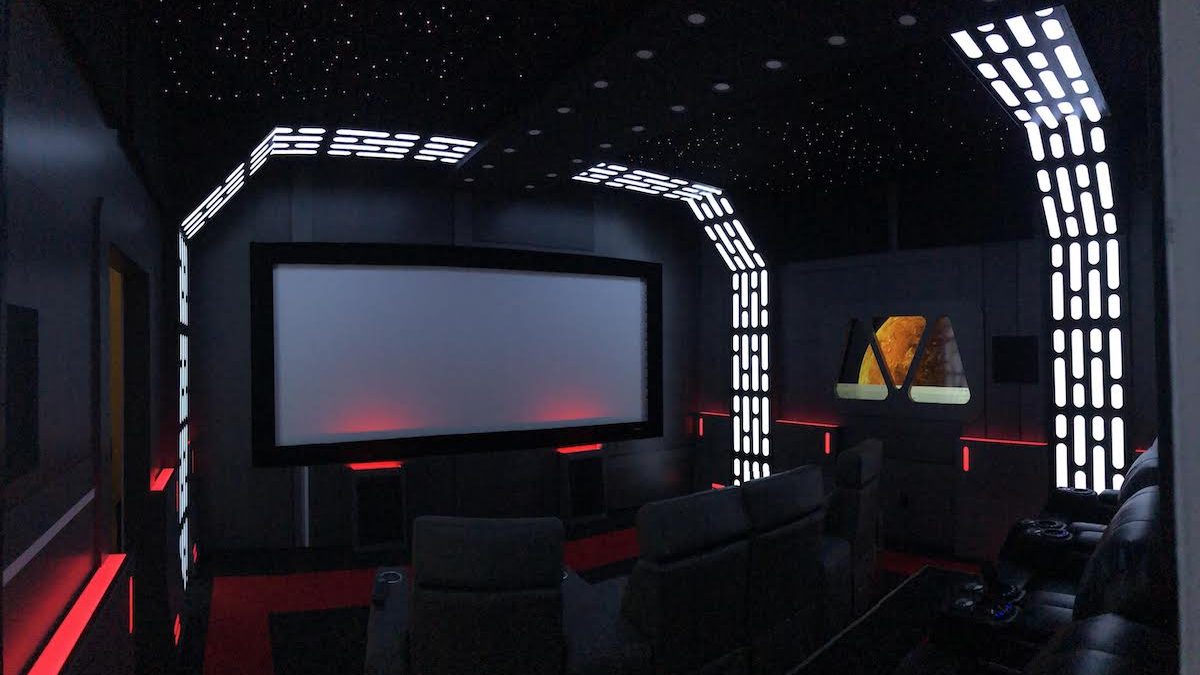
OneTouch House also wanted a showpiece; a flagship attraction that would demonstrate some of the best products they had to offer in a unique and spectacular way. As home theatres are also a big part of their businesses, we came up with the idea to design a dedicated theatre in the space that would be a place where both the staff and customers could enjoy a premium movie night experience. As both OneTouch House and I are HUGE Star Wars fans, we thought: what better way to create a unique space than with a theatre that resembles a theatre found on the Death Star?
The theatre project required a variety of skills, including:
- 3D modelling and rendering in Blender
- CAD modelling in SolidWorks
- CNC manufacturing of acrylic sheets and MDF
- Wall graphics and decal installation
- Creating a "window" out of a TV and MDF frame recessed into the wall
In January, 2019, we got to work conceptualizing the space - figuring out the layout, the aesthetics, lighting, and other elements that would make this the coolest home theatre space in Victoria. OneTouch House handled the electronics and movie equipment, as this was their expertise and they would know how to make the space come to life in the best way possible.
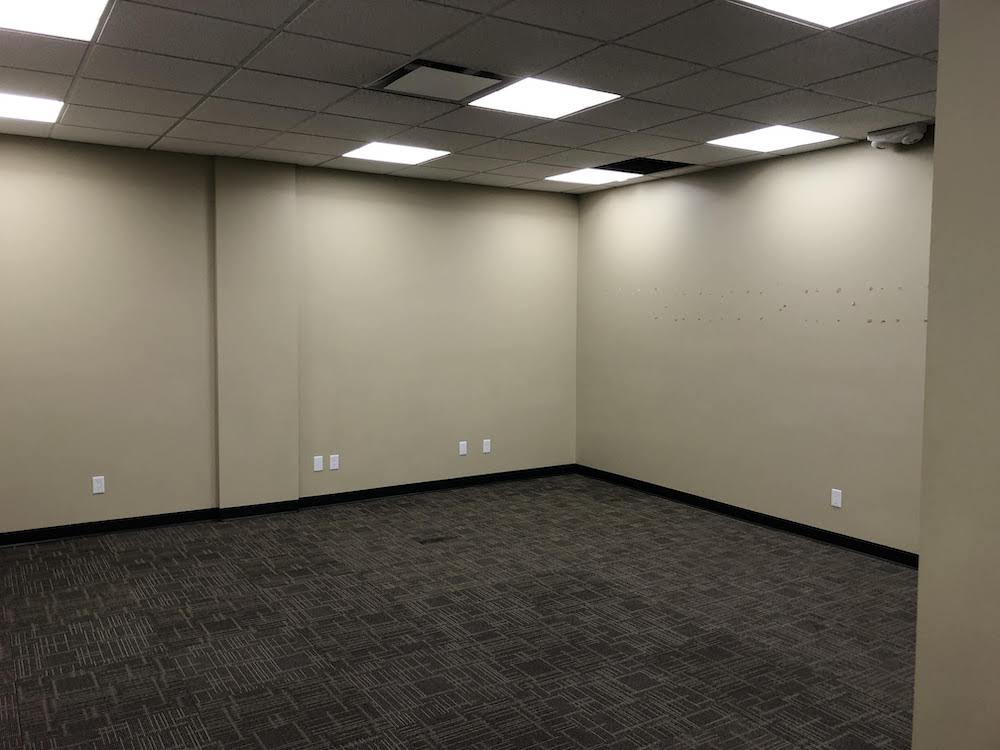
After just recently moving into their new space, the Encompass team came into measure the new OneTouch House showroom - currently just an empty office space with ceiling tiles and green wall paint.
Once we had a layout, we began the design process.
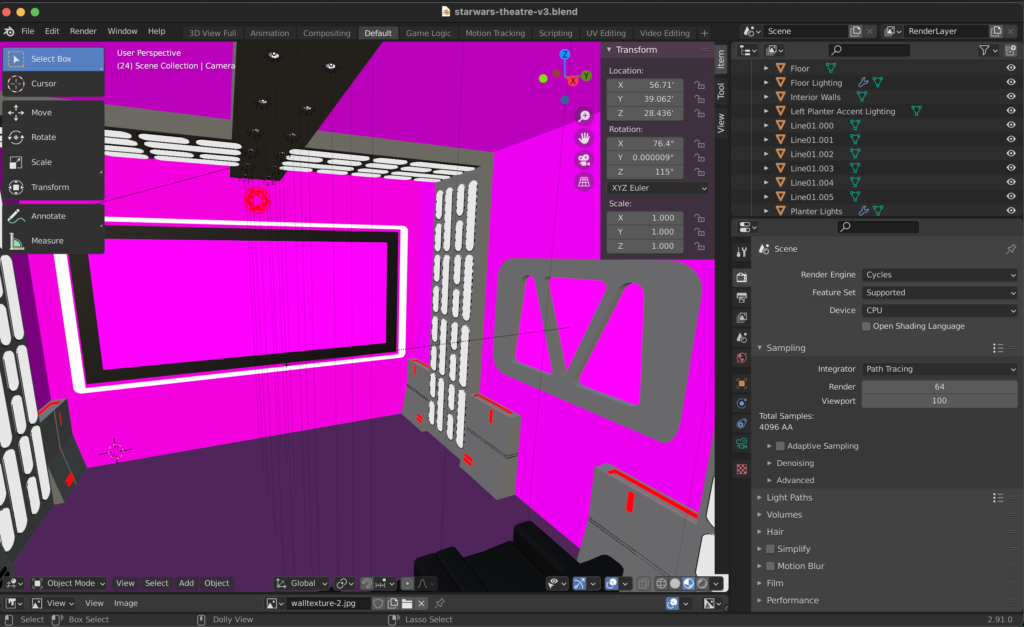
I designed the whole space concept in Blender and visualized the layout, decor, lighting and ambience of the room. Our goal was to make it look like the inside of the Death Star or an Imperial Star Destroyer - with a simulated window as if you were looking out into space. We took inspiration from recognizable elements, including the light pillars and science fiction-style wall paneling.
Once we had the design, look and feel nailed, my business partner, Stuart, got to work making my creative vision into real parts that could be fabricated. Using SolidWorks CAD modelling software, Stuart created the parts and drawings for the components in the room - from light pillar and wall decoration assemblies to acrylic sheets for the light pillar covers. With the experience and expertise in construction, OneTouch House handled much of the building and installation aspect of the room with the parts that we had fabricated for them.
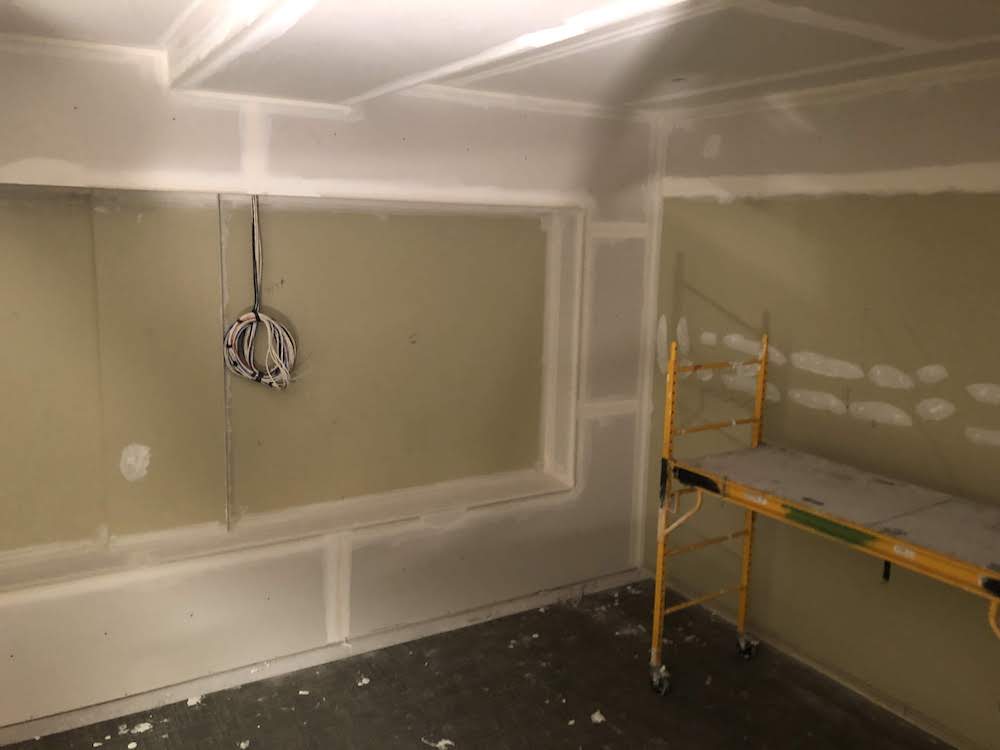
As parts were being fabricated, it was now time to get ready to prepare the space for conversion. Walls were put up to separate the theatre from the rest of the showroom, sections were cut and framed into the walls for the movie screen and window, and the platform was built for the rear row of seating.
Once the room was prepared, the first step was the wall graphics to provide the core foundation for the aesthetics of the room.
I designed the wall graphics to have a 3D effect, with valleys and channels that emulate a wall panel in a spaceship. This created a realistic yet cost effective way of covering a large space and making it appear textured.
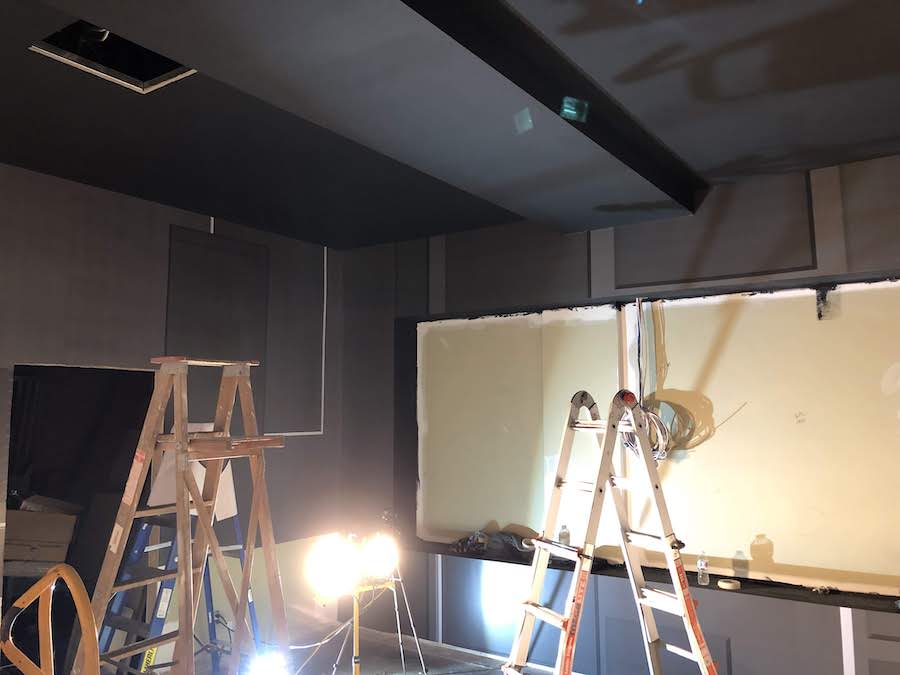
The graphics were then printed and installed by Renoson Auto Films, an extremely professional team of wrap installers (and a client of ours). The graphics were installed over a few hours and the room was beginning to take shape.
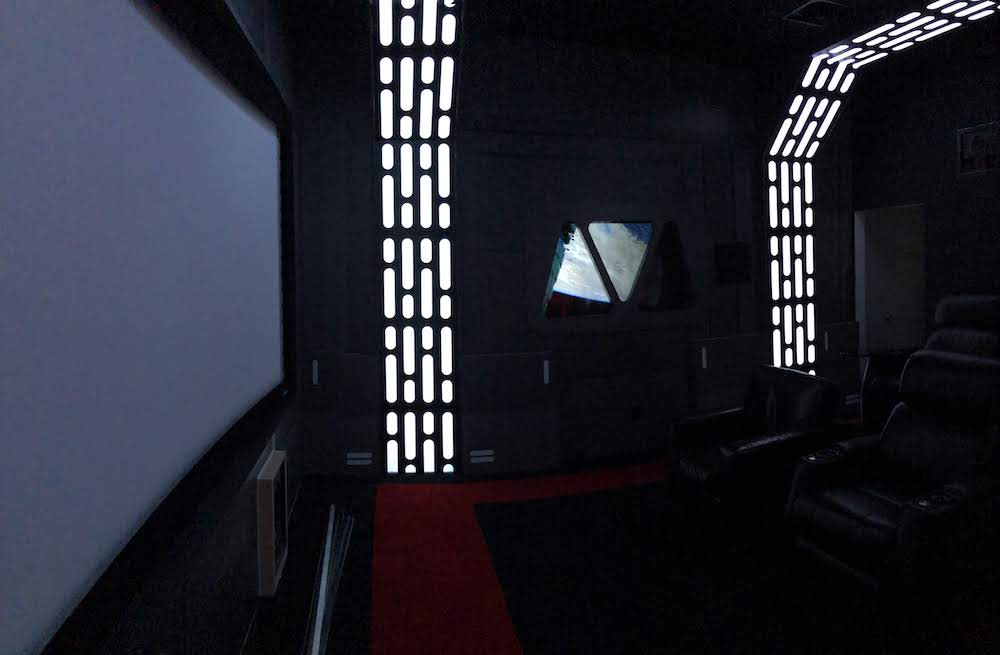
Following the installation of the wall graphics, it was now time to put up the four 12-foot light pillars that provided the main decorative element for the room. Based on the drawings that Stuart put together and CNCd out of MDF, the light pillars were assembled in place, painted white on the inside to reflect the most amount of light, and lined with LED strips from floor to ceiling.
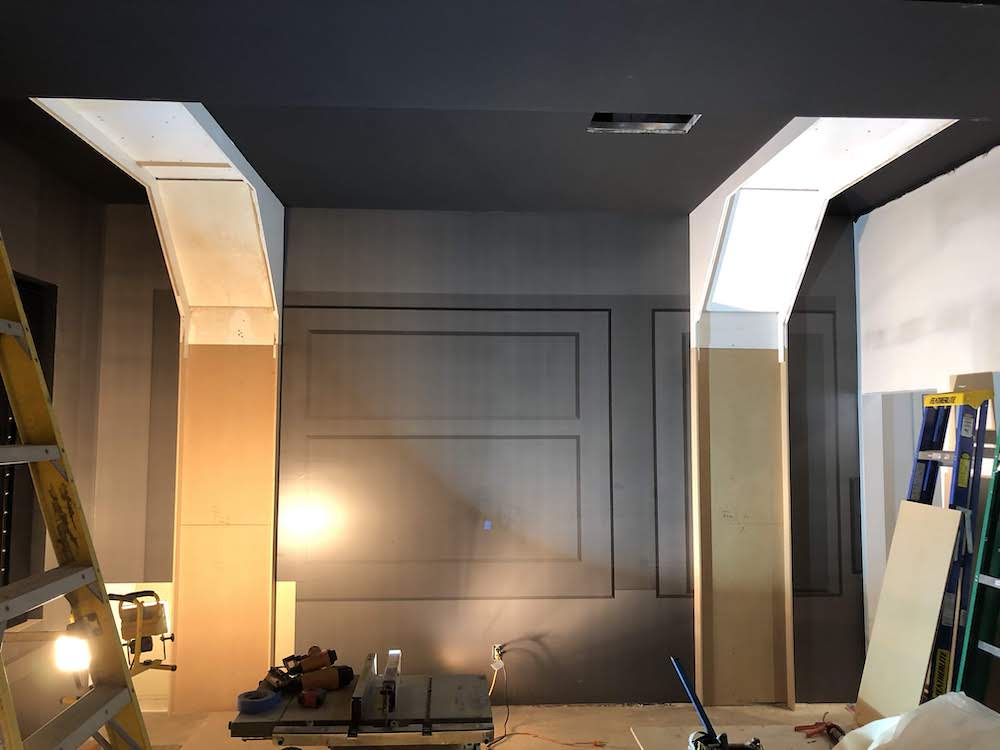
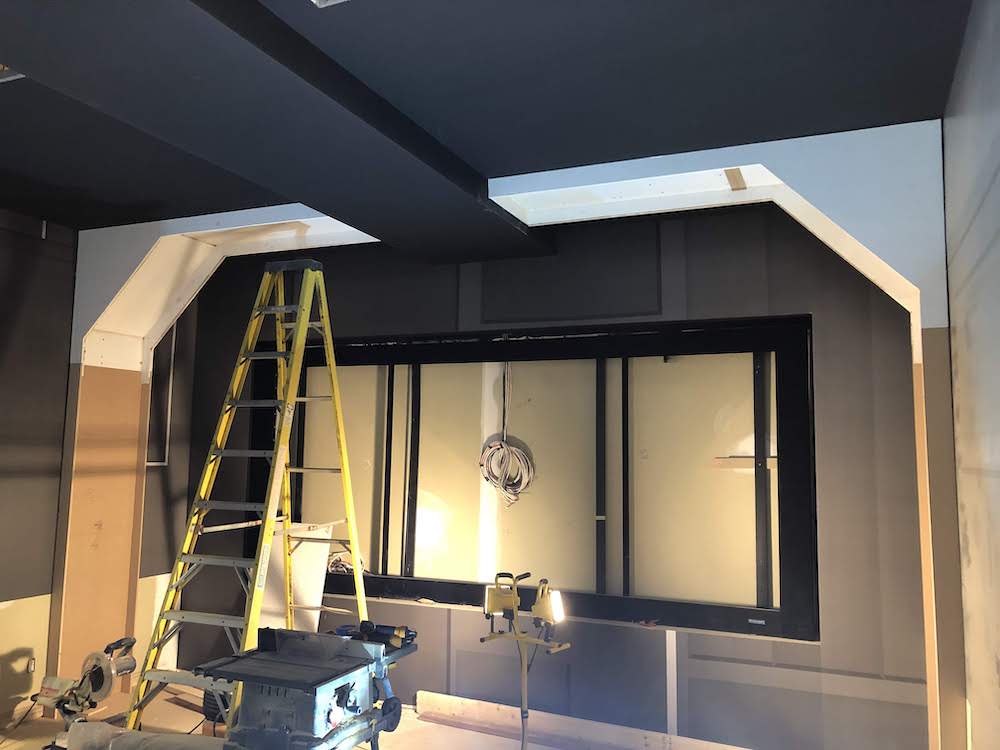
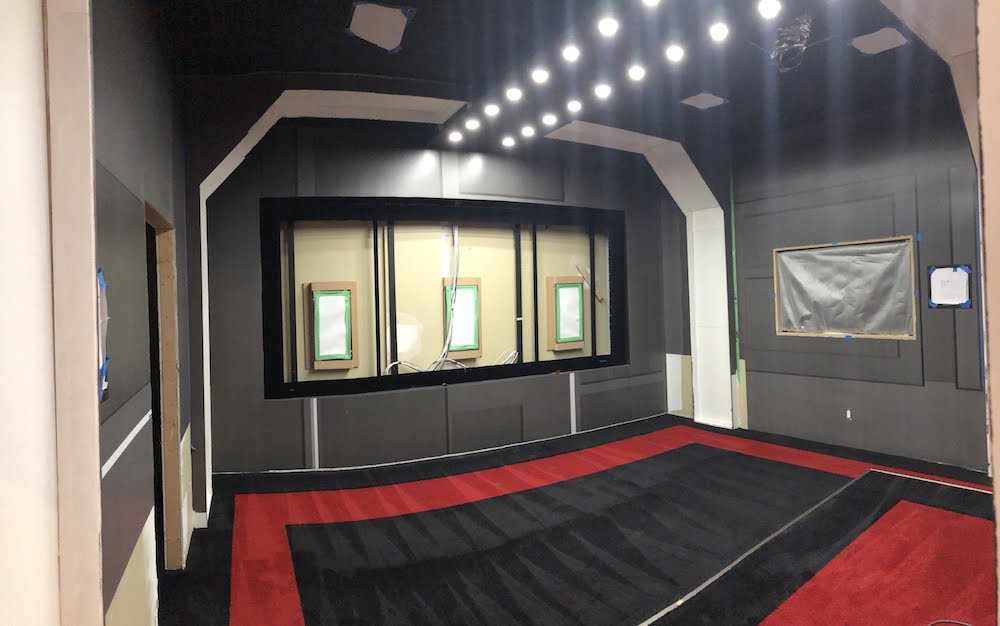
The light pillars were then fitted with a frosted acrylic sheet to create the diffused lighting effect. A black vinyl decal was placed over the acrylic sheet, which provided the iconic oval pattern and created an awesome effect in the room.
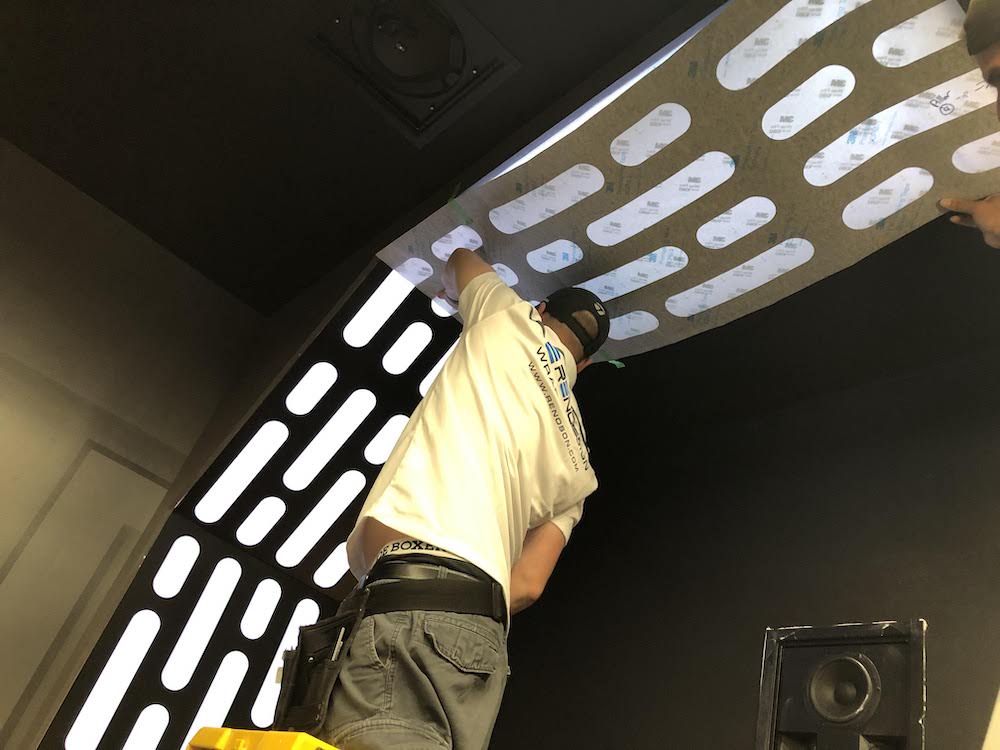
The theatre was beginning to look like the inside of a space craft.
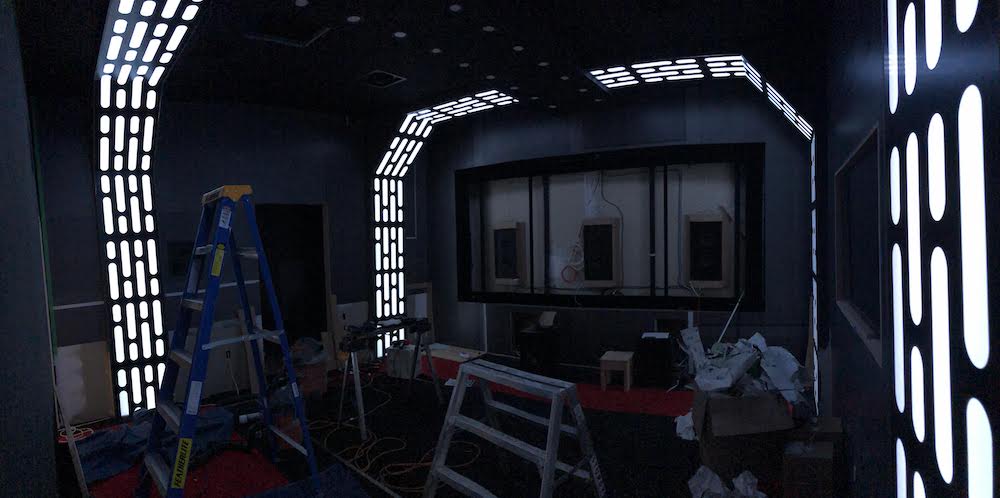
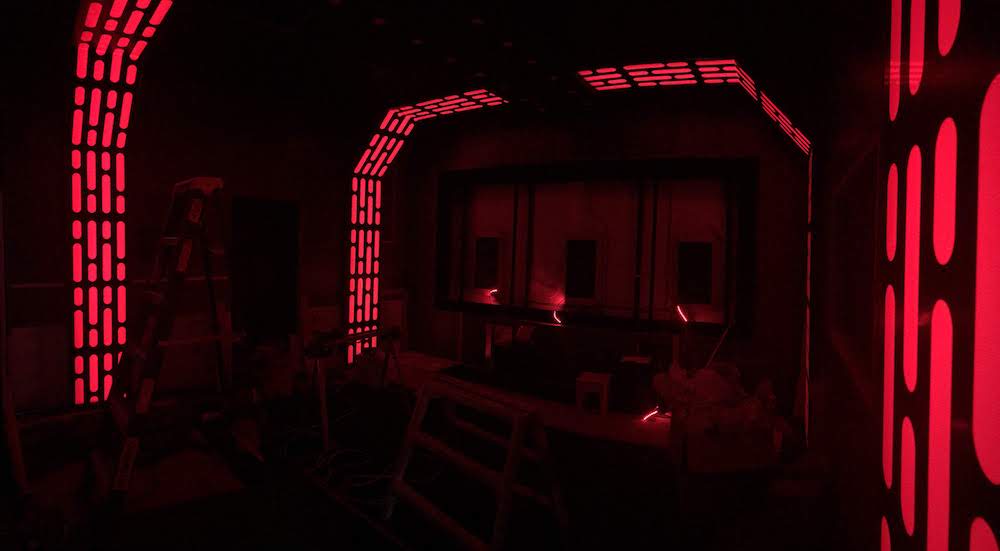
An additional element to add realism and ambience to the room was the three foot high light boxes that spanned the length of the room on each wall.
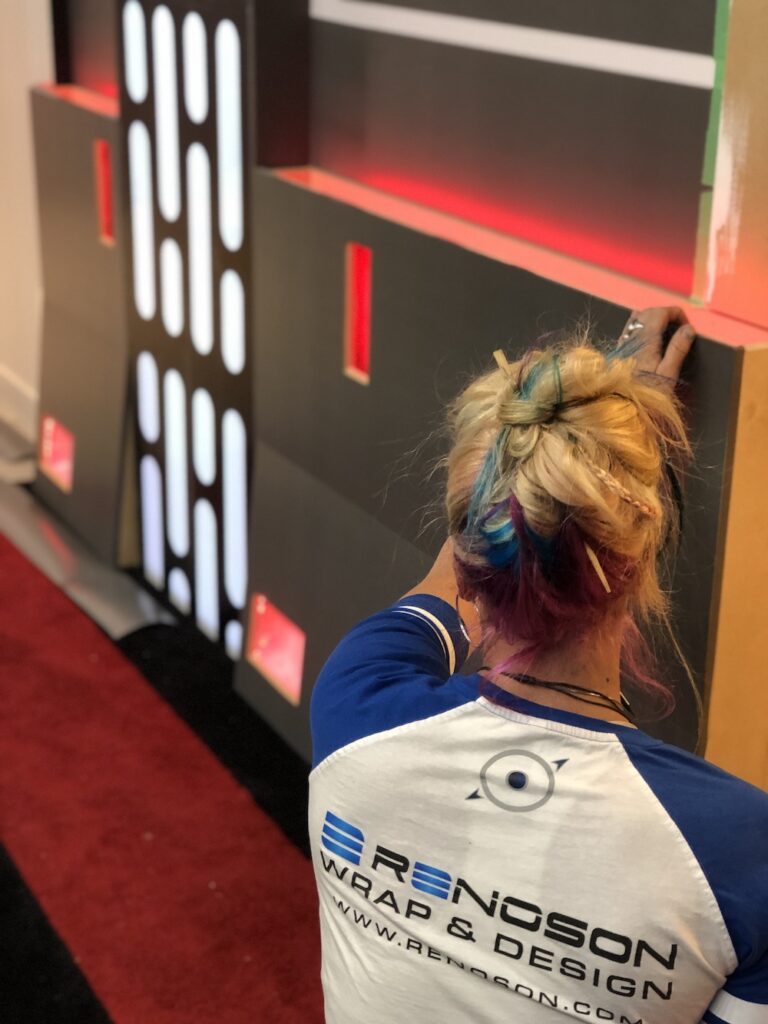
Each light box was machined out of MDF and assembled on site. They were lined with LEDs and fitted to the wall. Acrylic panels with another oval decal were fitting into the openings to diffuse the light and add decorative ambience to the room. The boxes were then wrapped with wall graphics to blend them into the rest of the room.
One of the coolest elements in the room is the 3D window recessed into the wall to simulate looking "out into space".
To accomplish this effect, a hole was cut into the drywall and framed in slightly larger than the size of the TV. The TV was mounted and cables run out the back of the wall to a wall panel that OneTouch House to grant access on the other side of the wall.
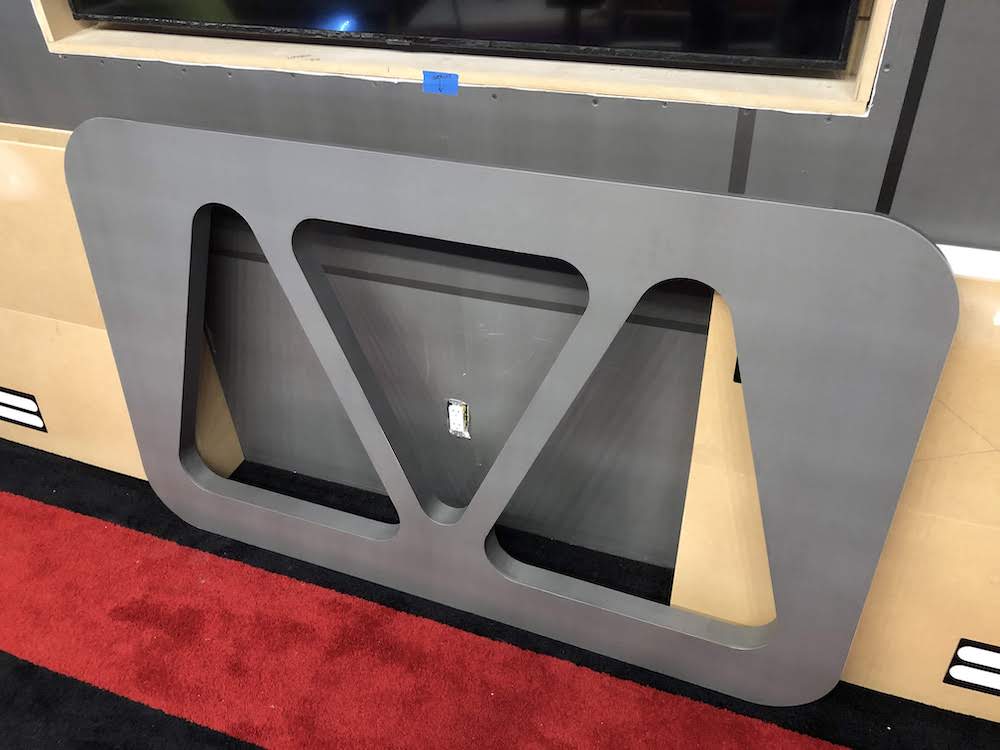
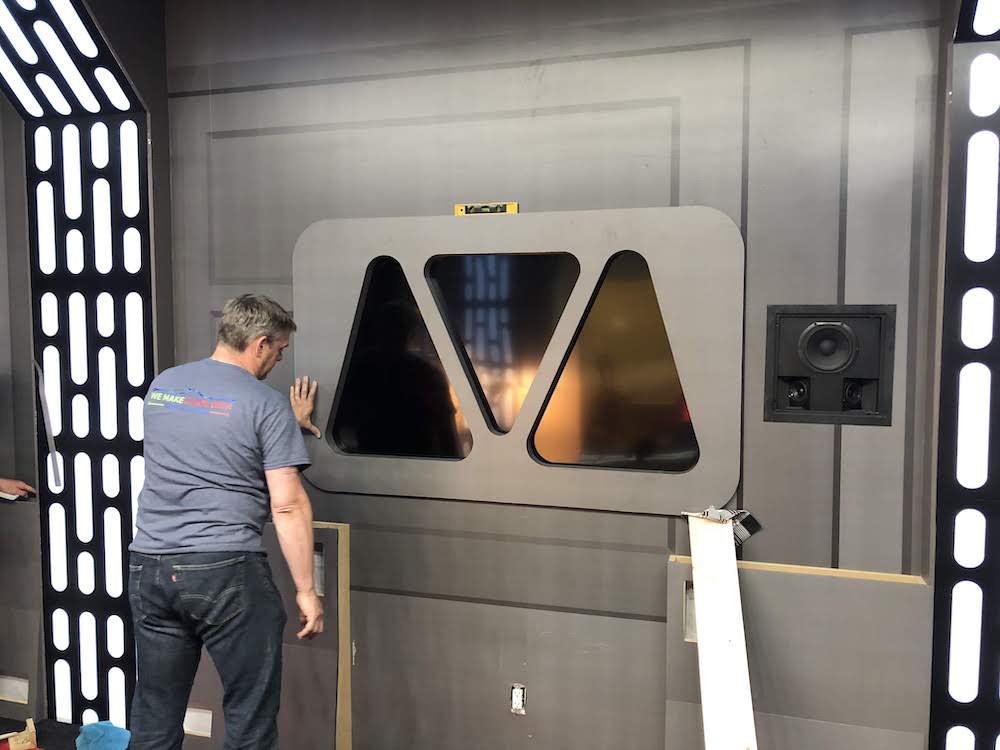
Once mounted, an MDF frame was mounted on top of the hole. The MDF frame was cut in several different sized layers to create a "plug" that added thickness and emulated a window sill. The plug pressed up against the TV screen recessed into the wall and the frame sat proud of the wall to make look like the window was "inside" the wall.
The MDF frame was then wrapped in a grey wall graphic material to match the room. I built a custom animation sequence to be played on the screen when the theatre was idle to simulate ships cruising by - with rumble effects and everything!
Although this came later, the final piece to the room was the fibre optic starfield ceiling. A true movie-night "under the stars" experience was achieved using insulation panels, black (fireproof treated) felt and 500 optical fibres that had to be surgically threaded through the insulation panels. We literally used a catheter needle to insert into the panel and thread the fiber through.
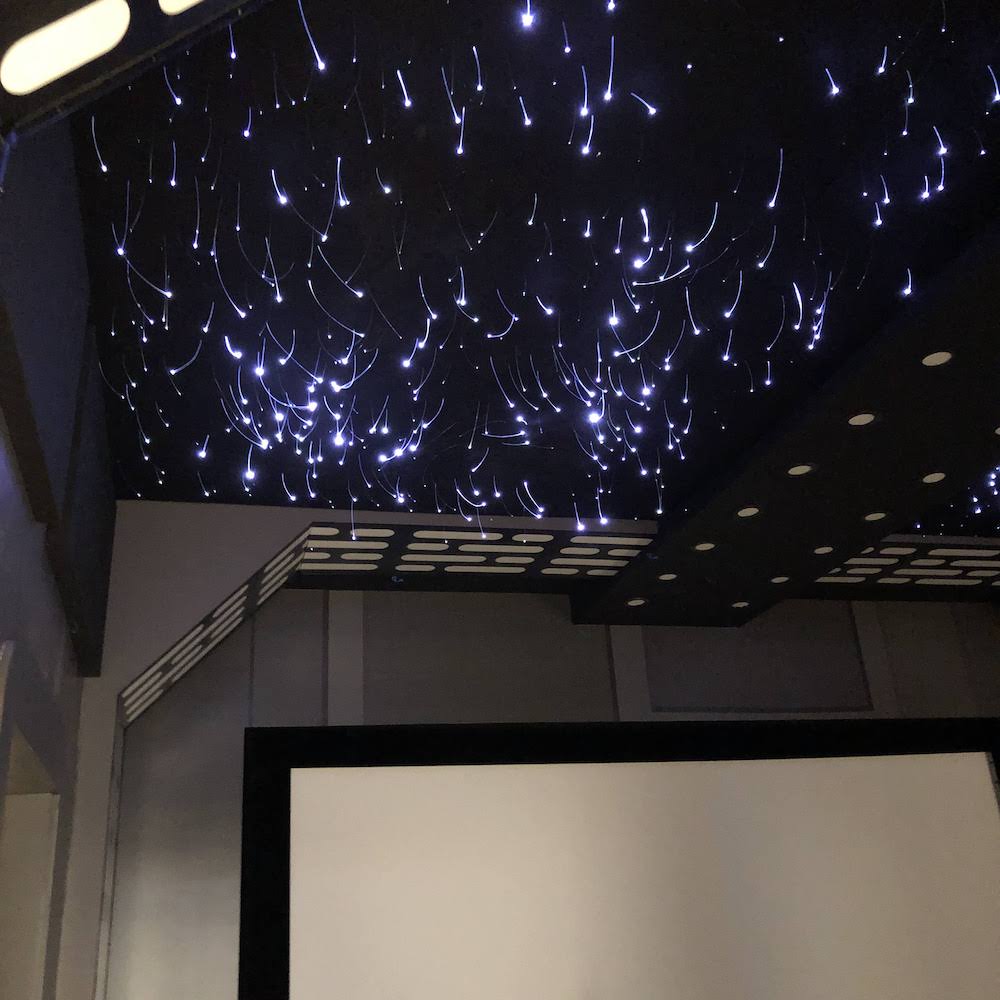
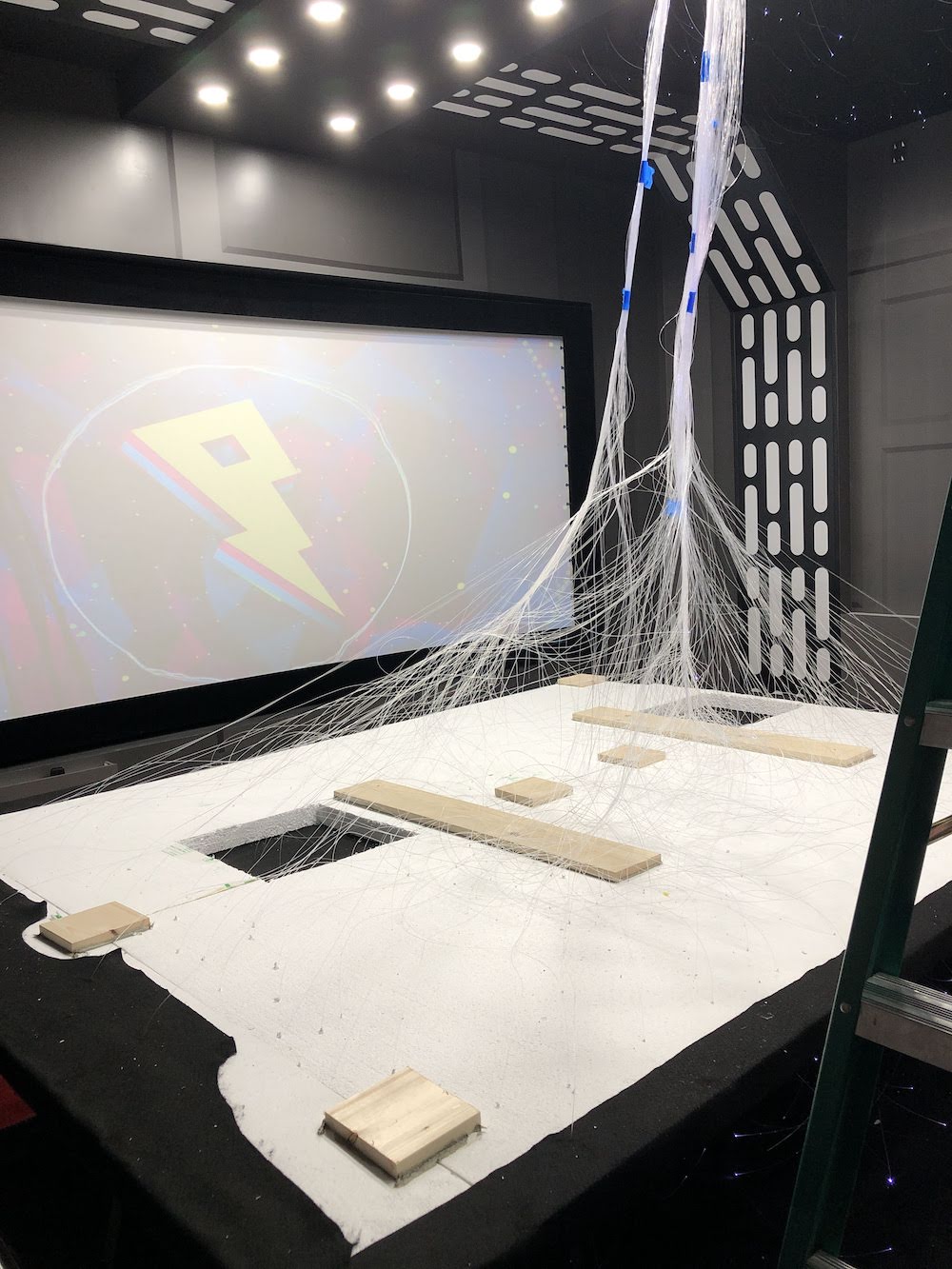
The panels were cut to size and wrapped in black felt. Once wrapped, the fibres were threaded through in a random pattern (minus one constellation that has to be found). The panels were then lifted up and mounted to the ceiling with 2x4 cut into square as spacers to create space for the fibres to run.
All of the fibers were then trimmed back to create the starfield effect.
The themed theatre project was a challenging but extremely rewarding project to undertake. I have enjoyed several movie nights in the theatre and the project also led to the Abduction! escape room project, which became our most challenging and comprehensive project to date - requiring all of my skillset and pushing me to learn so much in a variety of areas during the process.
OneTouch House is a home automation company that has been serving Vancouver Island and the Gulf Islands for over 20 years. With an extremely talented team and a culture of professionalism and customer service, they have been a client of Encompass' since 2018 and it has been a pleasure helping them market and grow their business up to this point.
To learn more about OneTouch House, visit their website.
NOTE: Specific details have been omitted to protect the confidentiality of the gameplay
During the preparation for the Abduction! escape room experience, the world got hit with the COVID-19 pandemic. As the world scrambled to deal with the spread of the virus, the outbreak sent a shockwave through the business community as companies were forced to reduce operations or shut down completely. Here in Victoria, BC, the effect was no different as businesses were required to adapt as quickly as they could to minimize the loss of revenue caused by ceasing operations.
This obviously created a problem for our (Encompass) biggest project at the time, the Abduction! escape room experience. The game was a few weeks away from being complete but the regulations for how location-based entertainment businesses were supposed to operate were still vague. Being a brand new experience, and the first of its kind, this created uncertainty around the grand opening and reception of the new game. Our team had put in months of hard work and creativity to bring this project to life, and unprecedented circumstances put the whole project at risk.
Our client, Quest Reality Games, was searching for solutions to provide online experiences for customers during the height of the pandemic. Although several escape room operators around the world had begun to launch online experiences, the quality just wasn't there.
As an avid gamer growing up, I was used to playing triple-A titles on PlayStation and therefore had developed an internal standard of what makes a compelling experience. Granted, those titles often involve huge investments, which our client did not have the capacity for. As we had developed our relationship and demonstrated our capacity for software development and storytelling, we began the discussion of converting one of their existing physical rooms into an online experience that was accurately represented and also engaging for the player - all on a proverbial "shoestring".
Creating the online experience posed three main challenges:
Challenge #1: Convert an in-room puzzle experience into a fully-fledged multiplayer online game for both PC and Mac, in a matter of months
Challenge #2: Ensure the game was accessible to the "casual gamer" while maintaining a high standard of gameplay
The one upside was the game content was already there. Since it was a flushed out game experience, we had an existing foundation to work with. It was a matter of making a physical game into a virtual one. We had some video content to work with, a storyline, and a physical room with real props we could use for reference. The game wasn't an escape game, but a "who-done-it" crime scene investigation style game where the players are presented with a crime scene and have to figure out who the culprit is.
We decided to keep it a "first person experience", similar to the real game. Players would walk around the room, investigating objects and finding evidence to analyze later at the lab. The game was to be played on a mid-range (or better) desktop/laptop and had to be compatible with PC or Mac to maximize accessibility.
Our first course of action was to figure out how we were going to do it. I have extensive experience with game development tools like Unity, and the Abduction! experience was coincidentally built using these tools. Therefore we were essentially creating another game, but instead of it being an escape room that runs on a PC game in a physical space, we were creating a more conventional "video game".
We took pictures of the room and measured the space to create a space-accurate 3D model that could be used in game. After designing and modelling the layout of the room, we added props and assets to start filling out the room and making it look the way it did in real-life.
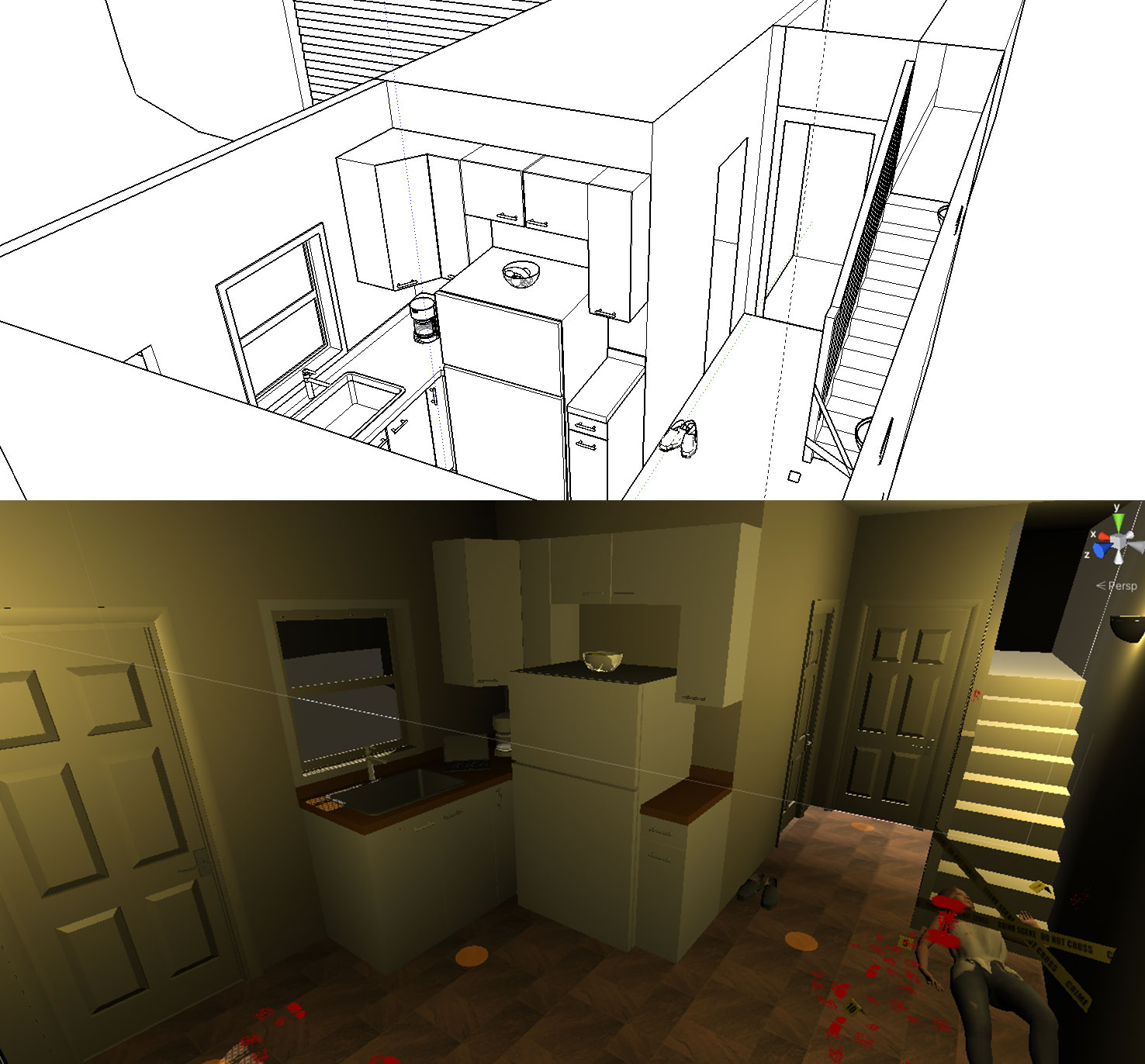
This part was relatively quick as we had a reference to go from and tried to match it as closely as possible. Although, as it was a video game, we didn't have the physical constraints of a real building so we could take some liberties with areas that did not actually exist in real life - including sound effects and other rooms/doors. This included adapting the "crime lab" to a first person experience instead of an actual room.
Arguably biggest non-technical challenge we had was adapting the gameplay style to an automated, online experience.
In the physical game, players have to fill out a report to illustrate their understanding of the events that transpired based on the evidence they found. A real person (game master) has to manually review the report to confirm whether or not the players were correct in their analysis.
Automating this process created a variety of obstacles as we had to make sure players input the correct information so they didn't get penalized for using a different word even though the answer was correct, while also ensuring that we didn't inadvertently give the answer away based on the question. The answers then had to be analyzed with no human interaction and the players would be scored based on their analysis.
After deliberating back and forth on how to solve this problem, we decided a series of multiple choice, dropdown, and manual entry answers that automatically capitalized the user entries to ensure consistency, while penalizing them for misspelt words or incorrect answers. The process worked and created a cohesive gameplay experience that both challenged the players and adequately analyzed their answers to the puzzles correctly.
Another challenge to the gameplay experience was allowing for multiplayer gameplay for up to 10 players. As Quest's physical rooms were designed for collaborative experiences, creating a game designed to be single player wouldn't accurately represent that game we were aiming to replicate.
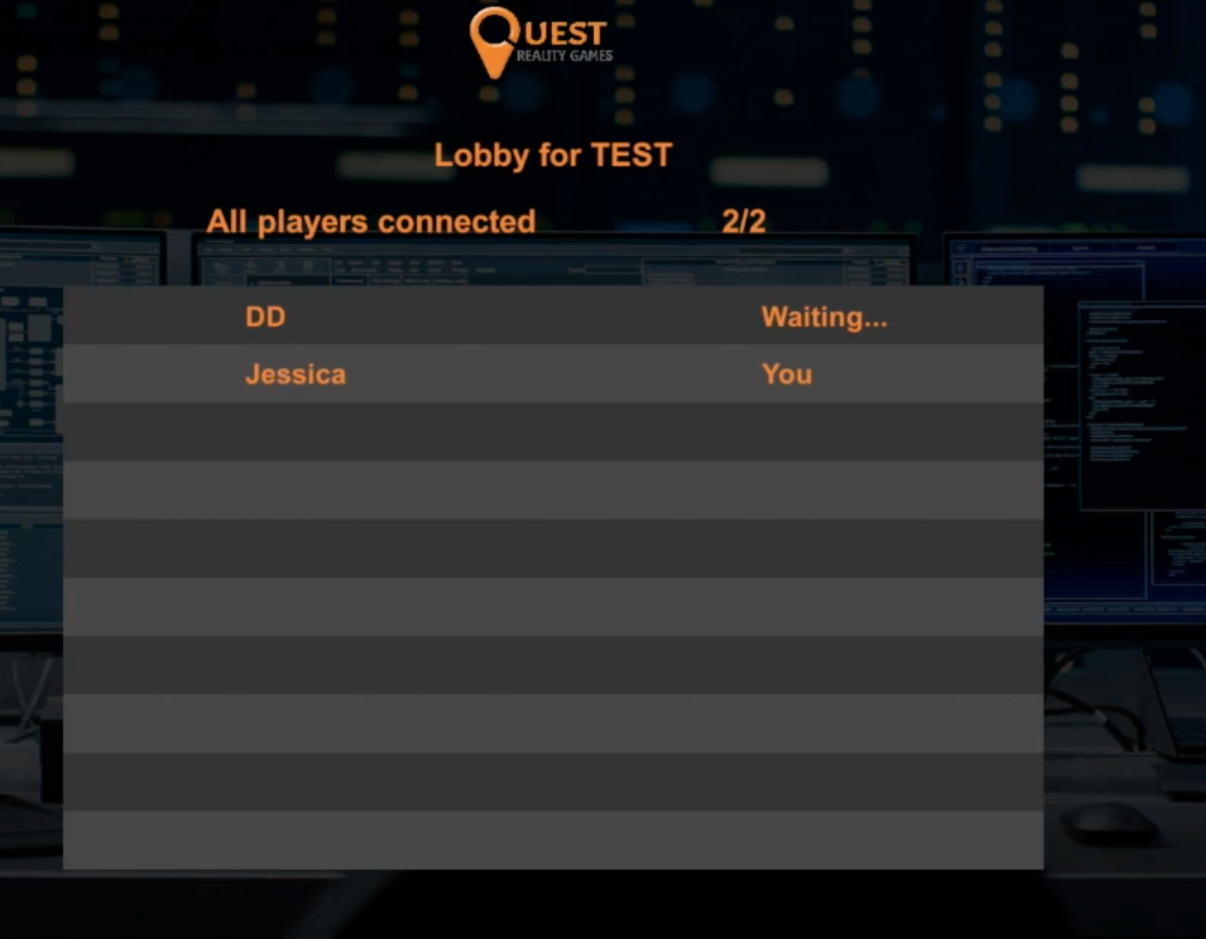
Our solution to this, based on the timeframe and budget we had, was to create a cooperatively competitive gameplay experience. Players were scored individually based on their analysis of the evidence, but their scores were combined to contribute to the overall "team" score. Players could assist each other in figuring out what happened and as long as one person correctly influenced the others, the team would do well. If not, individuals may do well but unless the team performed as a whole, the team would not score well on the analysis.
As a gamer myself, picking up any video game title and playing it requires a relatively small learning curve. I understand button layouts, general game mechanics, and can figure out the basics of any game relatively quickly. However, not everyone is a gamer and we didn't want to limit the scope of the game to people who were already comfortable playing video games. We also didn't want to alienate actual gamers by introducing strange game mechanics or an unfamiliar concept.
We accomplished this in a few ways:
One of the most common ways to move a player in a computer game is by using the W-A-S-D keys on the keyboard. Although the arrow keys make sense conceptually, using the letter keys keeps your left hand on one side of the keyboard and frees your right hand to push other buttons and use the mouse. Therefore, we allowed the user to move by using both the arrow keys AND the W-A-S-D keys on the keyboard. That way, gamers and non-gamers alike could understand how to move the player.
You know the virtual tours that real estate websites use to show a house from a 360 perspective? The concept is very simple - click on a button at a spot on the floor and the camera will move to that location. It's simple to understand and removes the need to use the keyboard to "walk" to a location. We implemented this feature as well so players could essentially move around the room by clicking on the floor and using the mouse to look around. We made sure to keep the markers random enough so it didn't look like that was where you were supposed to go to find evidence.
The goal of the game is straightforward - explore, find, analyze. When exploring the crime scene, we wanted to keep it simple and ensure that the average player would be performing actions that they were already familiar with when using a computer. Therefore, aside from moving the player with the keys or markers, locating and reading evidence involved clicking on items in the room to determine if they were evidence or not. Some evidence was marked, other items were not. This kept it somewhat ambiguous as to what was evidence and what wasn't.
While exploring the scene, players don't have to think of anything else except moving and clicking. No complicated key combinations, no hotkeys - just move and click.
Although we built the game for PC and Mac users, we kept the game simple and chose not to include adjustable settings or parameters. The experience you get is the experience we designed for you and therefore, the issue of accidentally changing settings doesn't exist with the game.
The game is also light, meaning that it doesn't require heavy graphics processing to run. There is lighting and shaders throughout the game to add some sense of realism, but keeping it simple meant that the average user could play it and still have an enjoyable experience.
Quest Reality Games currently uses Bookeo to manage the bookings for their experiences. It's a simple tool that allows customers to purchase time slots for specific games, and the whole process is managed automatically through their service. They show up at their purchased time slot and away they go.
An online game, however, doesn't need to be purchased for a specific time slot. It be played at any time throughout a 24-hour time period. This opens up several possibilities as there are no staffing, logistics, or operational concerns to worry about (minus server capacity). So how would be make the Bookeo system work for an online game?
We took the concept of "rooms" quite literally. In a physical escape game, players purchase a time slot for a specific room and they have effectively booked the room for a certain number of people. We used this same concept for the online CSI game, while removing the constraint for time.
- Select a "time slot" from the website. The time is irrelevant, it's just how Bookeo works
- Choose the number of players and enter in the information
- Confirm their purchase using a credit card and the order is placed
- They receive a booking number via email that can be used to grant one person access to the game
- One member of the group (the purchaser) opens the game and starts a game session by entering in the booking number they received
- The game references the Bookeo database for Quest and searches for the booking number, which also contains information such as which experience they purchased, and for how many players the game was purchased
- If the booking number exists and the criteria matches, the host is allowed to create a session (room) for the allotted number of players
- The room name is then shared with the other players and they can join the newly created session
- The host starts the game, and everyone has up to 90 minutes to complete the session
This process integrated nicely with Quest's existing system and allowed customers to find the online version the same way they would a physical game. No separate processes, no human intervention having to manually issue access codes, and a simple, consistent experience.
The game integrated with the Bookeo API so they could talk back and forth and automate the game verification process. It also helps eliminate piracy or unauthorized playthroughs, while disincentivizing "cheating" as there's not much point in purchasing the game just to know all the answers.
Building the CSI online experience was a challenging and rewarding project. It involved thinking a little differently about how video games are conventionally developed and sold, and allowed us to create a timed, collaborative experience that represents the core elements of a physical escape game.
Our goal, moving forward, is to continue to improve and expand on this type of experience by improving gameplay and offering other unique titles that are recreations of existing rooms or completely original ideas.
- Visit Quest Reality Games
- Download and install the CSI experience for your operating system
- Purchase a booking code
- Open the game, create a session
- Solve the Case of Melanie Burton!
One of the biggest challenges many of the businesses I work with face is the ability to manage ongoing projects and share information related to each project across the organization efficiently. Making sure every department or team member has the information they need to do their job properly ensures that the team as a whole is successful.
There are dozens of project management tools available, all of which are powerful and offer a ton of features to suit a variety of needs. Another challenge with these tools, however, is adopting them across an organization. Some teams are more resistant to change and, more often than not, these tools are only as effective as the people that use them.
Unless the whole team uses the tools, they are essentially irrelevant.
When I look for tools to use myself, I focus on a few key features to ensure that.
Arguably one of the most well-known data management software options available is Microsoft Excel. With its row and column layout, the ability to perform functions on data, and an easy way to format cells to make the information easy to read makes Excel the most recognizable applications around. It has even led to the various imitation tools such as Google Sheets and LibreOffice.
My favourite view in Airtable is the Grid View, which arranges data in exactly this format. Scroll down for the various records, scroll right to see the data related to those records. Simple, recognizable, and intuitive.
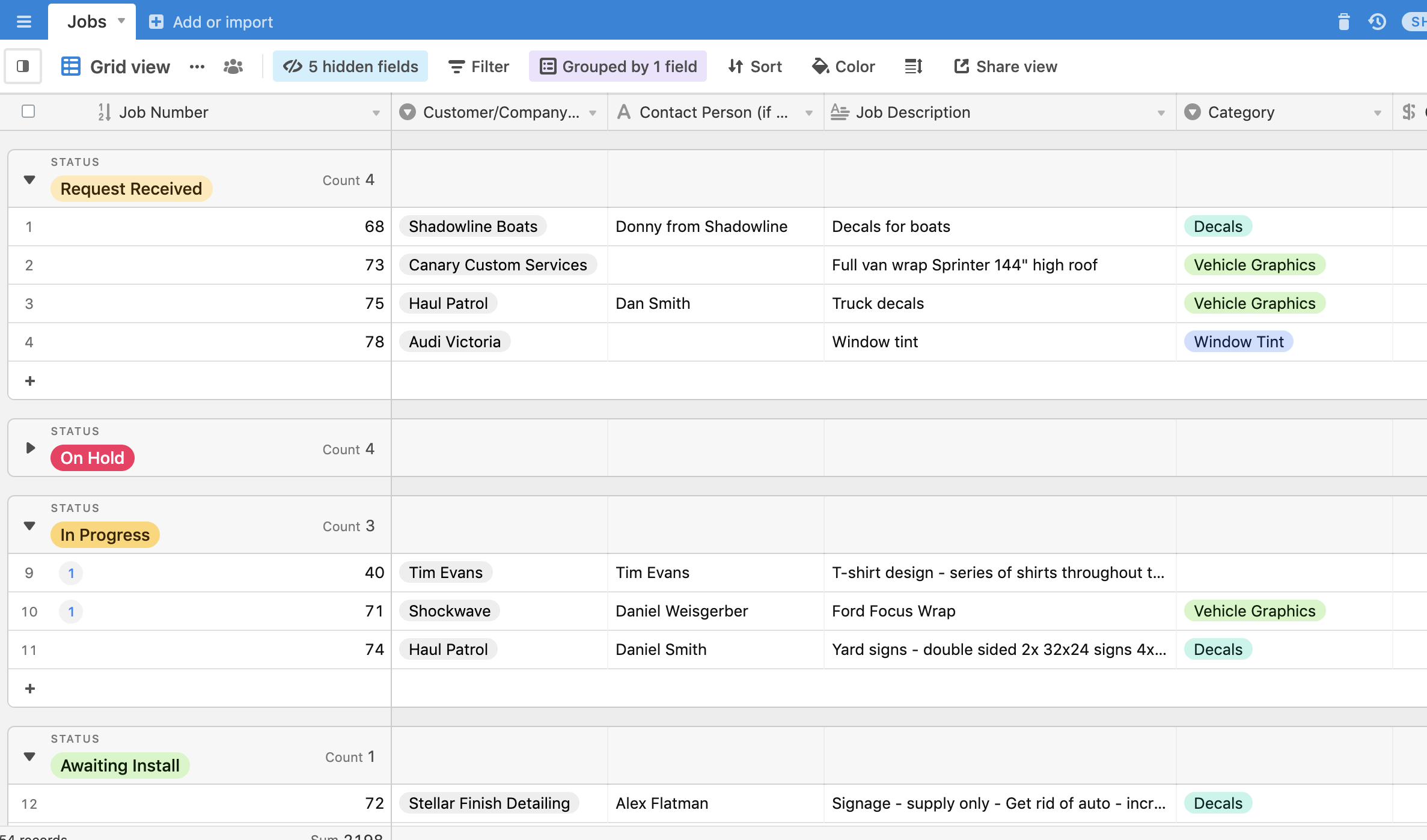
The columns can be arranged to provide the most important information up-front and records can be sorted by specific information to allow for better task/job management.
Other views include Kanban, Gallery, and Calendar.
In this article, I will discuss how I implemented Airtable at Renoson Auto Films to help the team collect information for new jobs, manage ongoing jobs, and store customer and job information for easy access by all members of the team. I will also explain how I setup automations to manage customer relationships through follow ups/check ins and asking for feedback in the form of personal messages and Google/Facebook reviews.
One of the most critical parts of customer acquisition is ensuring that the customer's needs are heard and understood. Depending on how the business operates, generally one team member is responsible for handling the customer request, and another team member (or department) is responsible for carrying it out. Making sure the information is transferred between teams (and team members) is critical.
For Renoson, I setup a simple database designed to capture and display key information related to the customer and their request.
Key information such as:
When jobs are added, they are assigned a unique job number. No two records can have the same number so this ensures that all job information is kept separate from other jobs for the same customer, or even the same project.
When the record is generated, a folder with a pre-determined file structure is created on the Renoson server I set up. This file structure is where the team can collect assets (logos, fonts, images), generate design and print files, create mockups etc. for each job.
If I create a new job number 82, the customer is Paradigm Autoworks and the job is to create an alupanel sign, a folder is created in the Paradigm Autoworks folder on the Renoson server with the name 82 - Alupanel sign.
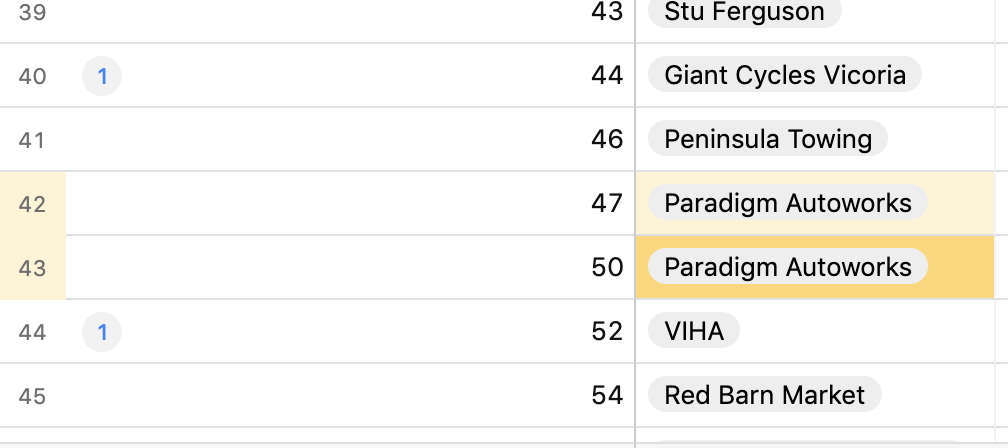
When a team member is looking up job history for Paradigm, they can search for Paradigm in Airtable and get all of the jobs performed for that customer with their unique job number and description. They can then look up the files specifically related to that job by referencing the job number with the folder created on the server.
Team members can also see other information related to that job, including time spent, the job quote etc. This can help with future job costing and comparison.
So accessing and viewing records is one thing, but what about easily creating them in the first place? More often than not, team members and taking requests via phone, or even in person, and therefore need an easy way to add information to make sure it's captured correctly.
This is where Form View comes in.
Once you have your database set up, you can create a form for entering records into the job list easily, from any device. You don't need an app installed - just an internet enabled device with a browser.
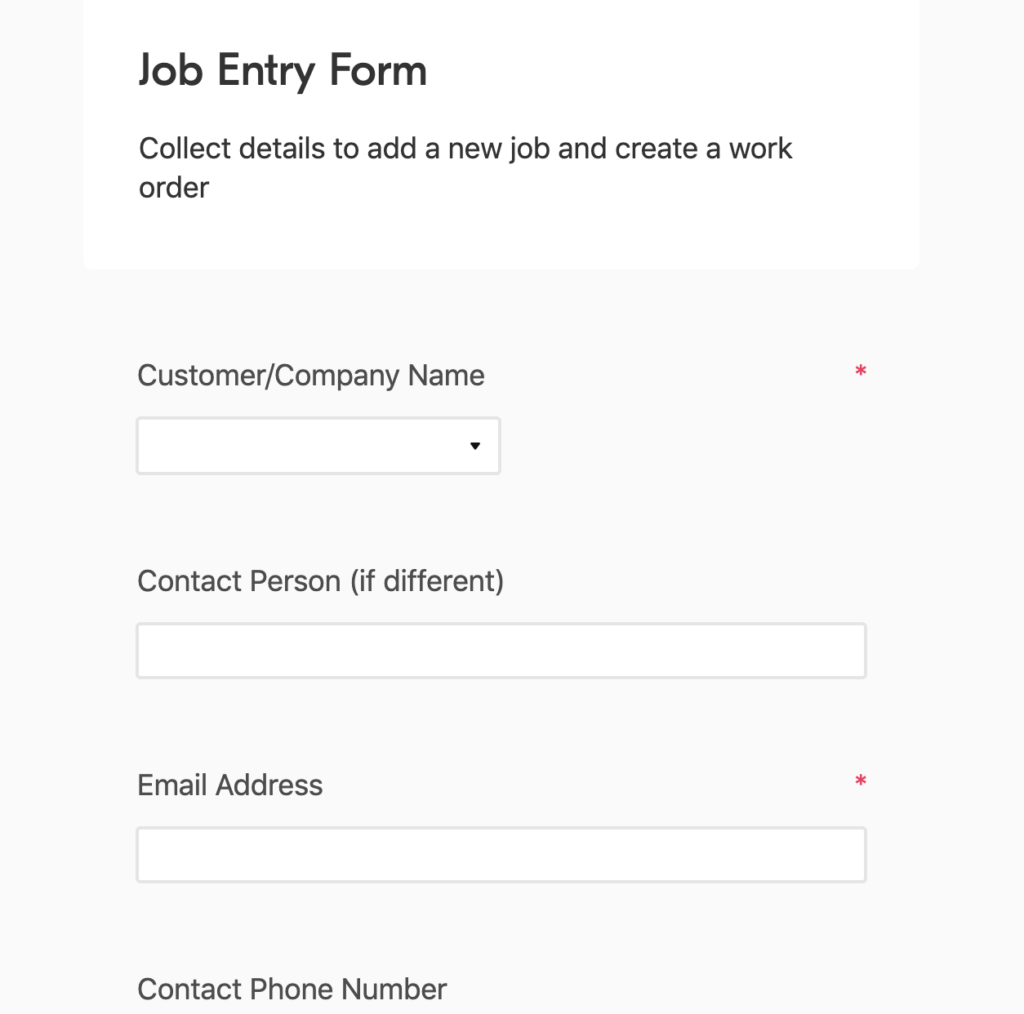
With Renoson, I setup the form and created a shortcut on the shop iPad that allows the shop team to quickly access the form and collect information right on the shop floor. The name of the customer, contact information, job description, and job category can all be captured easily through a basic form.
A unique job number is assigned and the record is added to the database and all of the important information becomes available to the team.
I also setup different automations, which are triggered when specific events happen. I'll get to it but if you're impatient, jump ahead here.
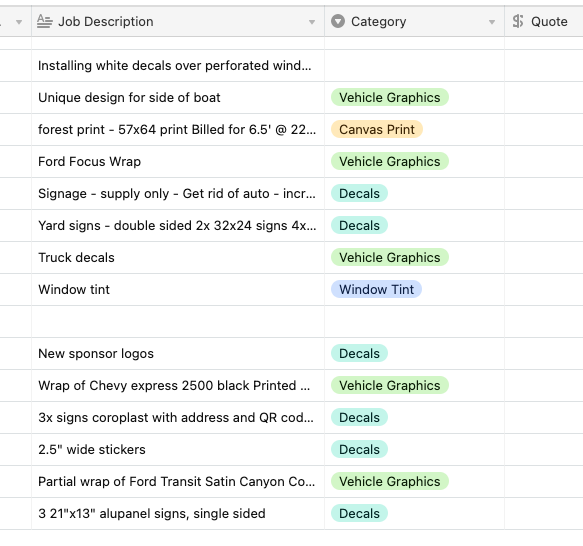
For many businesses, as customer lists grow and services get expanded, it's important for team members and various departments within the company to be able to identify customers and the services/products they have purchased. This is helpful for onboarding new employees, either as replacements or to scale the operations. Categorizing previous jobs helps segment customers into corresponding groups for either re-marketing or identifying which services are more popular than others.
Renoson offers a variety of services, from paint protection film to vehicle wraps, decals and signage.
Paint protection film is a consumer-driven market, with the end user generally being the purchaser for their own vehicle. Decals and signage, however, are generally purchased by businesses for commercial use. The marketing of these two products requires different approaches and so building a customer list and profile of the type of person who purchases these helps generate new and repeat business in the future.
For Renoson, I built in a job categorization feature that helps differentiate the different types of jobs. Discussed in the automation section later on this article, categorizing jobs also tailors specific follow-ups and emails specific to each type of customer.
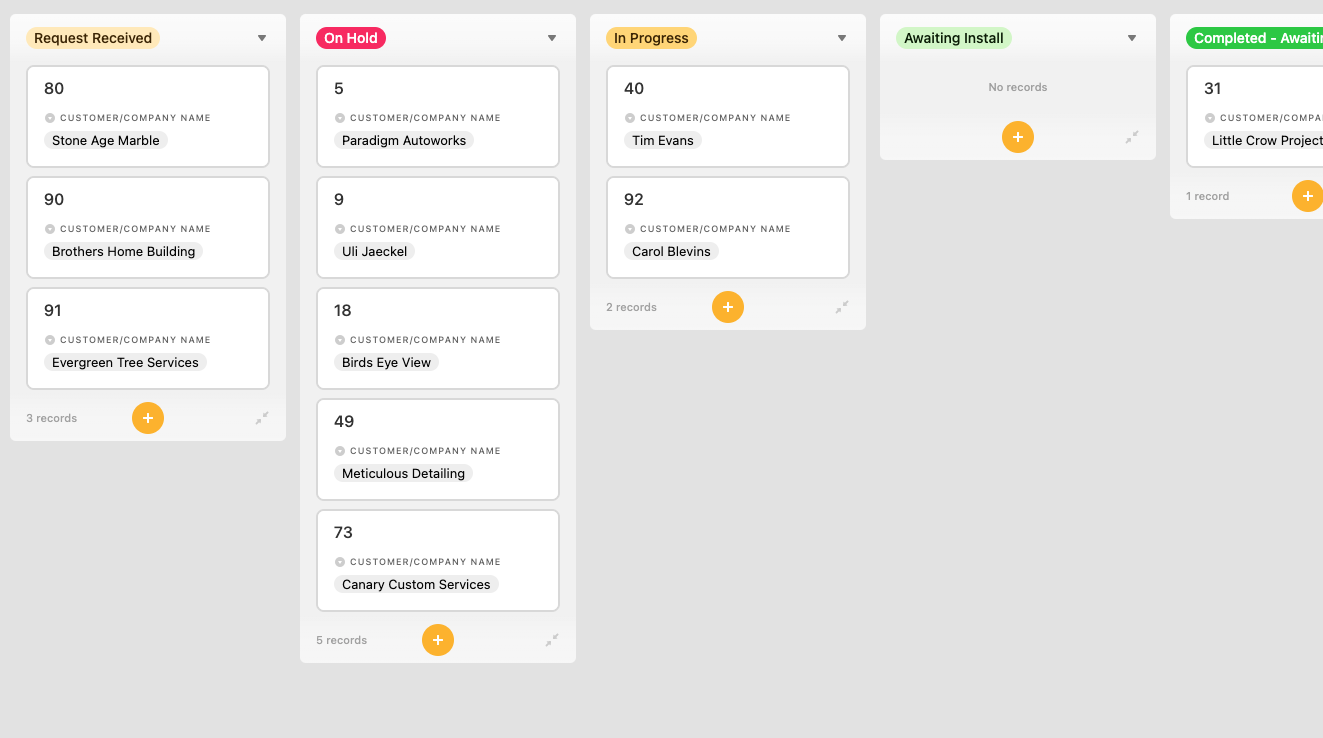
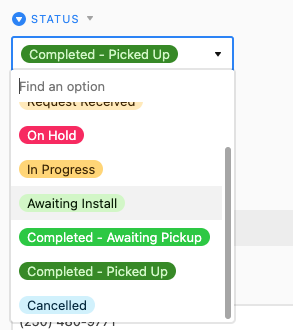
Once the job/order has been received and entered into the system, managing the flow of the job through the pipeline keeps everyone in sync across the team - from production to installation to sales and administration. At any point in time, an employee can check the job list and see where a job is in the process and update it as it moves along. This is especially helping when informing customers of their job status.
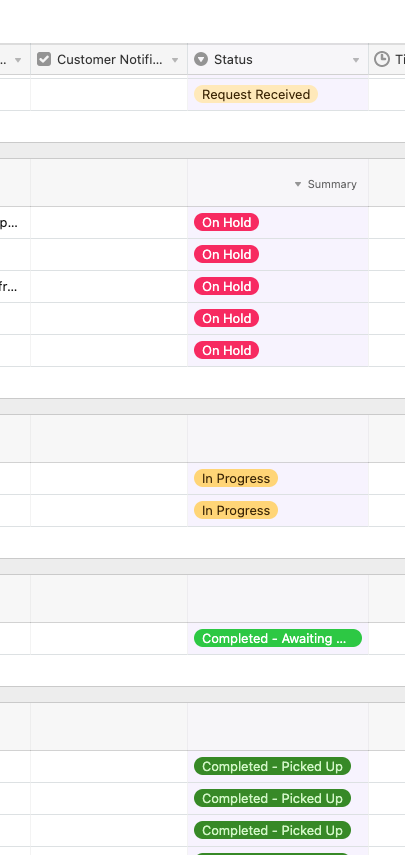
For Renoson, the vast majority of their jobs involve multiple steps.
Vehicle wraps require:
Paint protection film installations:
The graphics department does not install the film on the vans. They are responsible for managing the design and prep of the graphics before they go on the van. This happens independently of the installation team, who may be installing multiple vehicles at the same time.
When the graphics department completes the prep, they change the status from "In Progress" to "Awaiting Installation". This triggers a notification for the installation department that the prints are ready and they can schedule the installation with their own team. All of the information, such as vehicle, wrap type, and the design/layout information are stored in the customer record so they know exactly what they need to do. They can also comment on the customer record for questions to each department, maintaining a central record of communication with the company.
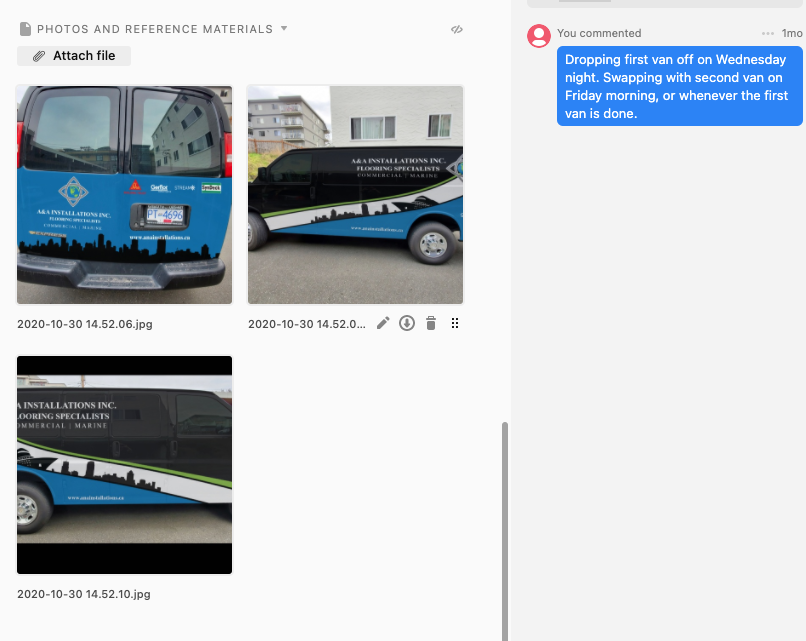
Having customer and job records helps the team keep track of what work was done in the past to make it easier to quote jobs in the future. Keeping the process simple and streamlined means than anyone can look back through the specific customer history and see:
I recently also used the job history database that was built for Renoson to launch a campaign to request Google reviews. Because we knew what work past customers had done, we could appropriately target them for requests. it makes the process more personal and increases the likelihood they'll respond to our request.
Aside from the record-keeping functionality and the inherent value that provides for a business, being able to create automations (ie. an automatic action) when information is added or records are changed saves departments across the business incredible amounts of time. One of the most common things I see with our clients is that they are too busy to do things like follow ups, appointment reminders, or keep information up to date if more than a few seconds is required to do so.
The system I built for Renoson takes common actions/inputs for job and project management and uses them as triggers for other tasks that may involve multiple steps. This has saved a ton of time and also makes sure the customer feels looked after and keeps Renoson front of mind.
Some examples of these automations include:
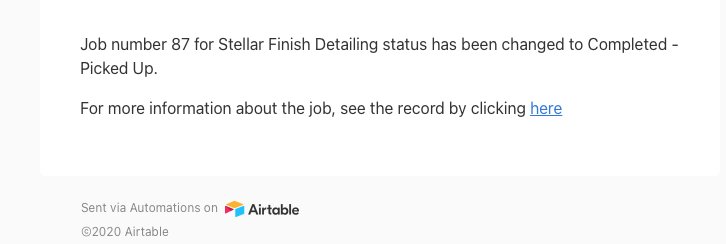
Overall, automations help simplify the flow information both within the organization, but also between the company and their customers. From segmenting customers and automating the marketing/communication process, to keep the entire staff in sync, the job tracking system I built for Renoson created a ton of value and benefits. The design of the system also allows for future expansion and customization down the road, so it will continue to grow as they do.
To learn more about how the system works or to ask about how a system like that can make running your business easier, feel free to contact me.
Renoson Auto Films is the Island's leading automotive film supplier and installer, specializing in:
Visit their website at www.renoson.com to learn more.
Sometimes, when people ask me “what I do” - as in, what do I do for work - I have a hard time thinking of how to respond. The truth is, I love to do so many things. Every job or role I’ve had, I’ve always taken something away from it. A lesson of some sort that has guided me as I’ve moved through my professional life.
Whether it be my first job as a cashier at Safeway and understanding how different people work, as well as getting my first taste of customer service. Or as an automotive detailer (and eventually shop manager) when I was 15 that taught me attention to detail and how to work with (and manage) a team.
Even through my marketing degree and landing a position with VRX Simulators, an ambitious and talented company with huge potential, I’ve always tried to soak up as much knowledge as I could, while bringing what I had to offer to the table.
For as long as I can remember, I have always been creative. Fuelled by curiosity and genuine entertainment, I’ve always enjoyed the concept of trying something that I’d never done before.
Now, especially after starting Encompass and immersing myself in the creative industry, I don’t consider what I do professionally “work”. Having the opportunity to tackle creative challenges for incredible companies from all over, is something I look forward to each and every day.
Each day is something new and different - a unique creative challenge to tackle. As I continue to learn new skills, improve my existing ones, and find engaging solutions to my clients' marketing problems, my passion for all forms of creativity will continue to push me forward in my career.
Take a browse through some of the things I've done in the past or drop me line if you have a specific question!
Cheers,

NOTE: specific details have been omitted to protect the confidentiality of the Abduction! experience
In January 2020, the team at Encompass was commissioned to design and implement an escape room experience. Even though we had experience with interactive experiences through the simulation industry, we had never performed this type of project before.
The introduction to this project stemmed from the Star Wars theatre project for OneTouch House. The client, Quest Reality Games, was also a client of theirs and saw the theatre. They were renovating one of their existing experiences and wanted a sci-fi themed room.
During the planning and design phase of this project, we had to overcome three main challenges in order to provide a different type of approach to the escape games industry.
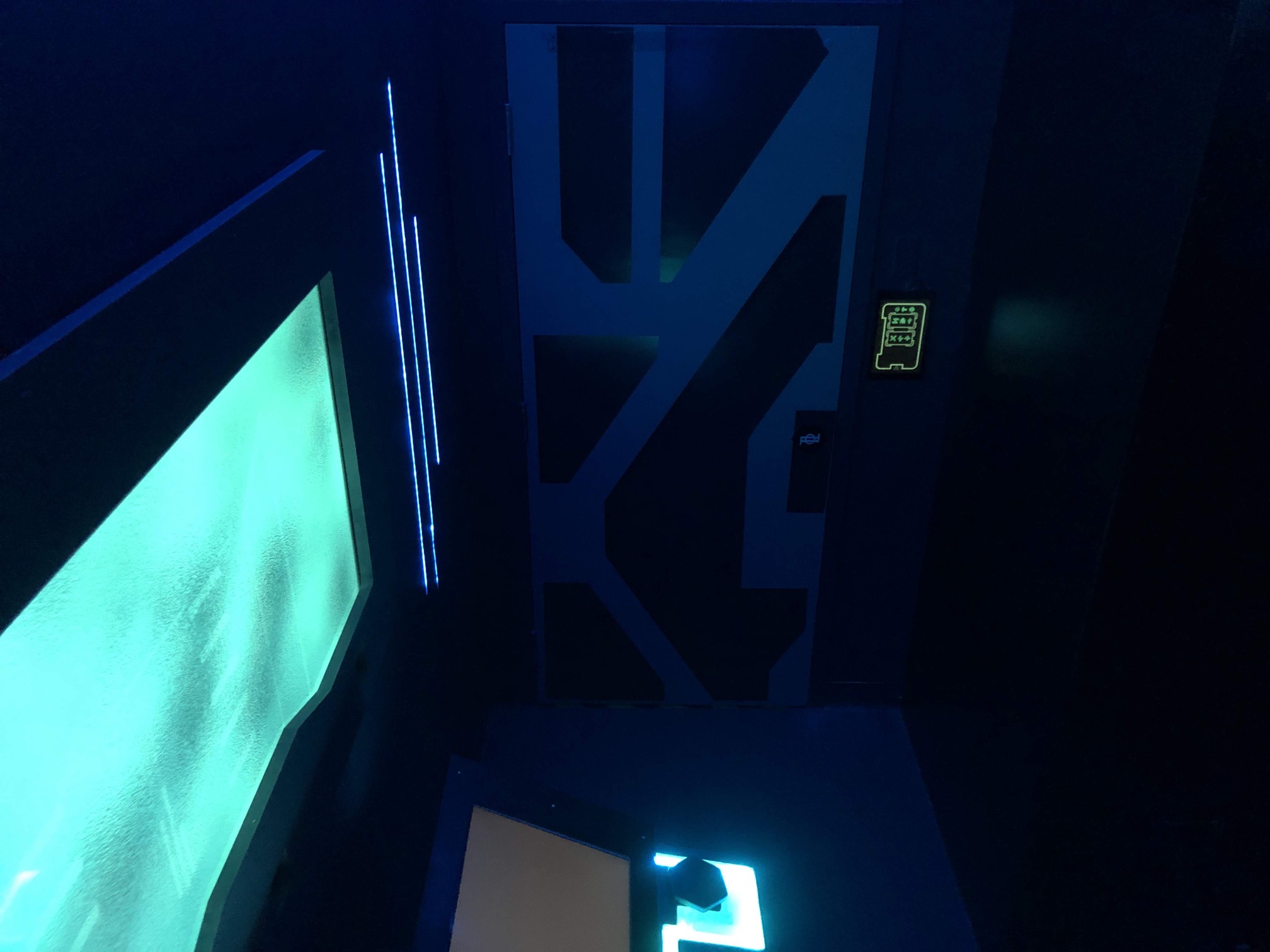
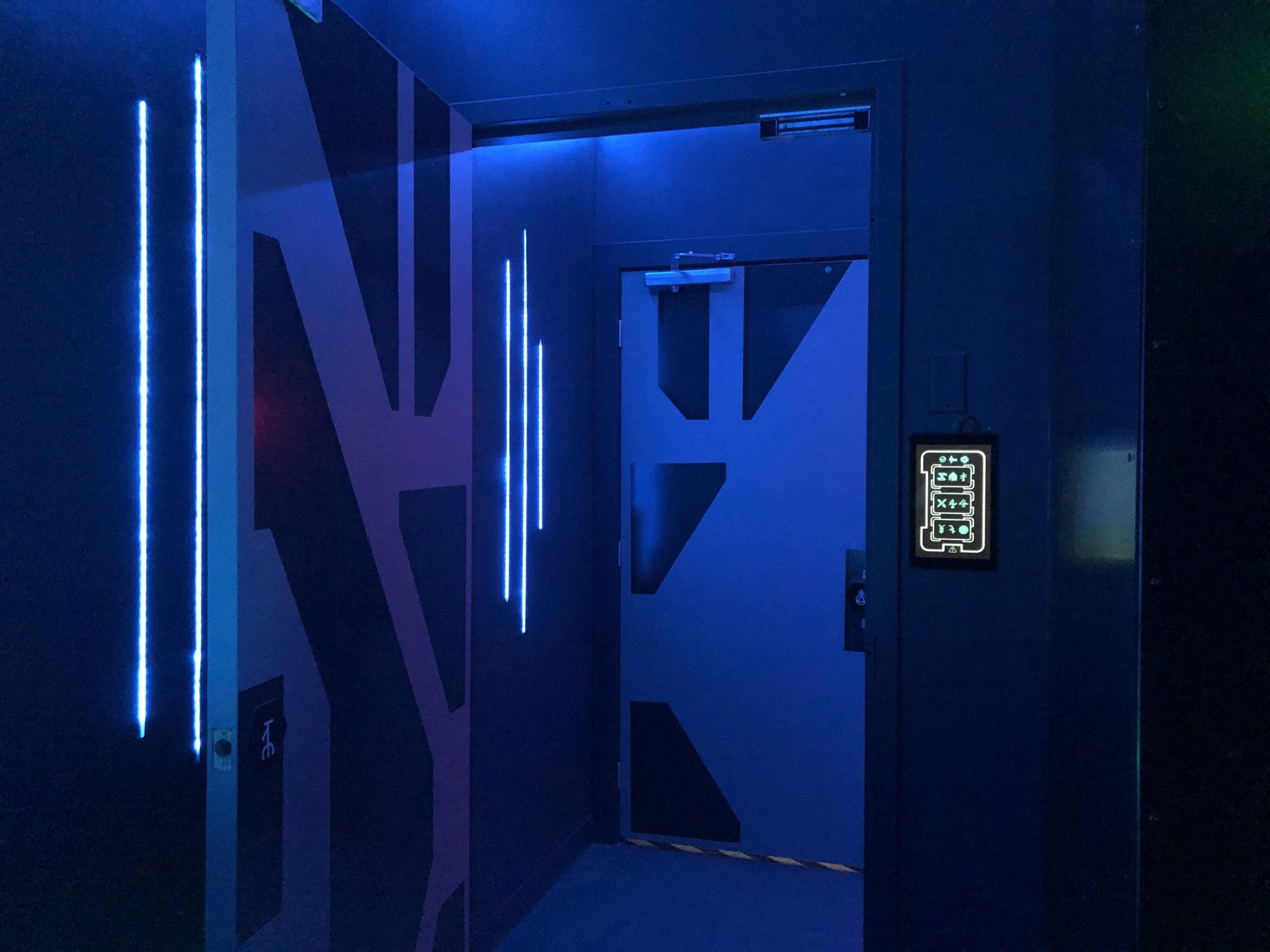
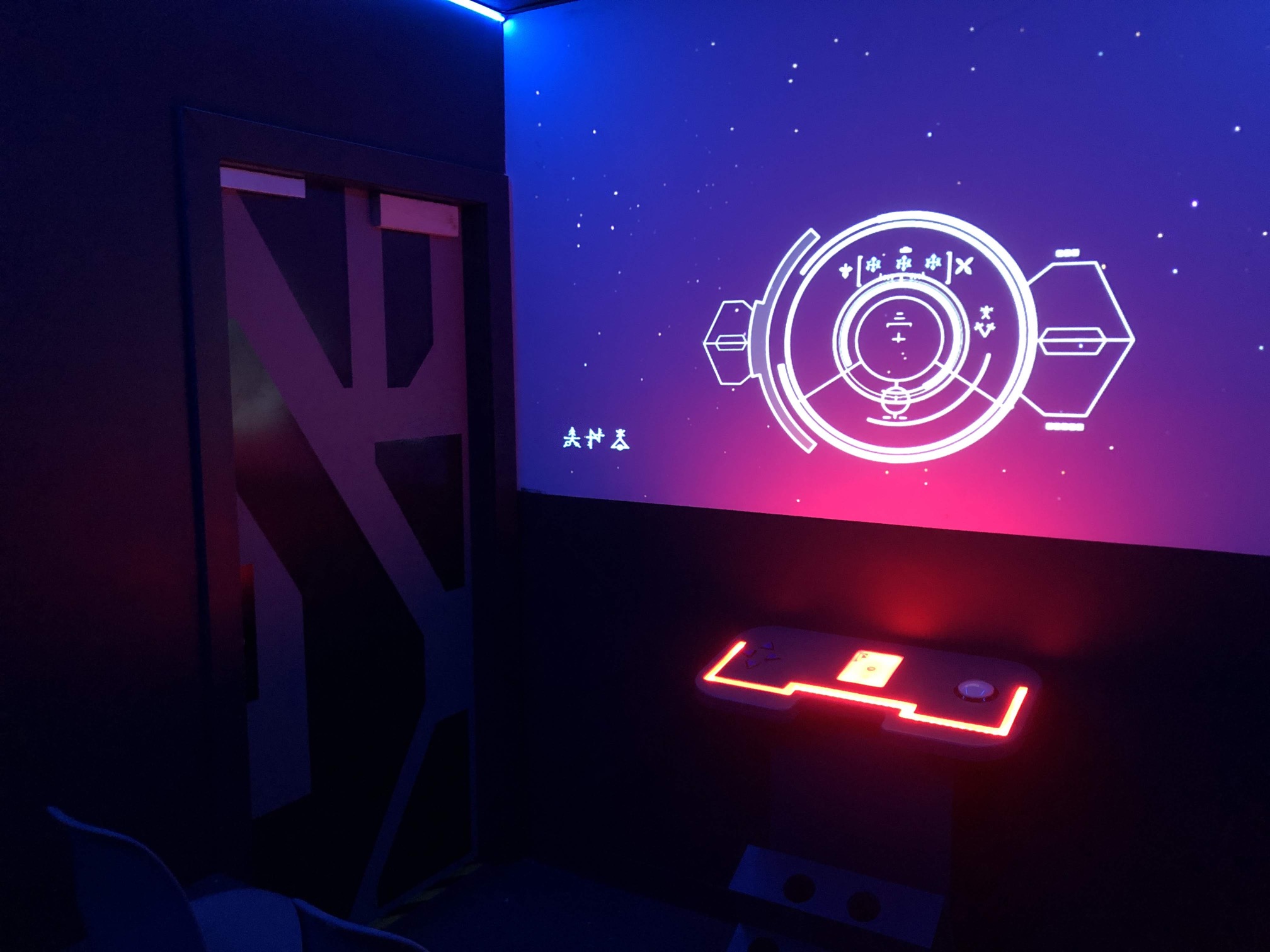
As entertaining and immersive most escape games are, the industry as a whole suffers from one fatal flaw: you can’t play the same escape game twice. Well, you can, but just like watching a movie twice, you already know what happens. Since the premise is to solve a puzzle, it’s difficult to replicate that experience of solving the puzzle once the puzzle has been solved.
Because of this, escape room operators would regularly have to update their rooms and, in most cases, have to completely redo the room once the return on investment started to decline. Although situated in a tourist hotspot, having no new experiences to advertise meant that off-peak business would decline.
Our goal was to create a dynamic escape experience that was primarily software-driven. This meant that puzzles could be altered in development cycles, the storyline could be modified depending on trends, and each time a user played, they could get a different experience.
When deciding how the puzzles were going to be structured and what we were going to use to create them, we had three main options:
To achieve a balance between replayability and realism, we decided to implement option three. Our puzzles used Particle Argon micro-controllers interfaced with physical hardware connected to each other via an internal UDP network.
Each puzzle has a physical element to incorporate it into gameplay - physical buttons, rotating dials, RFID readers, and relays for locks.
The game is controlled by a central PC that runs the core game experience - a game built in Unity that outputs to three displays throughout the room. The PC and the Particle boards communicate back and forth via UDP stream so each puzzle knows what state the game is in at any given time during the experience.
This allows the puzzles to trigger lighting sequences, launch sound effects, unlock doors, and generally move the experience along.
Because the core gameplay is managed via software and each is puzzle is independently programmed but integrated to the overall experience, new features and experience adjustments can be added to expand and alter gameplay - the entire game can also be changed to something completely different while still using the existing hardware components.
In the future, should the need to adapt the experience to a different theme (christmas, halloween etc), it can be done without removing or changing any of the current hardware. This makes the single room replayable several more times before the user has exhausted all variations.
Most conventional escape games that involve locks, physical puzzles, objects of interest etc. require the game to be reset between experiences. This is not only time consuming and involves allowing enough time between plays for resets, thereby decreasing the potential throughput of the game, it also creates the potential for inaccurate resets. An inaccurate reset means that puzzles may not be reset properly, objects required for gameplay are not placed in the correct spot or doors are left unlocked. This diminishes the experience for the next group.
Most escape room operators also require active monitoring of the experience to ensure that the players are directed through the game via hints or prevent damage to the room via mishandling of irrelevant items in the room. Generally, hints are requested via a walkie-talkie radio and the game master would ask a series of follow up questions in order to get an understanding of where the players are stuck.
Aside from labour costs attributed to the monitoring of the game, it also pulls the players out of the experience in order to talk to a game master via radio.
Our challenge was to reduce the amount of overall labour required to actively monitor and reset the room, thereby reducing direct labour costs and increasing profit-per-game.
To overcome this challenge, we implemented:
As the experience is story-driven, we hired a voice actor to play the “character” and provide a narrative through the game. As part of the script, we also recorded hints in order to weave the narrative into the hint system and keep the players immersed in the gameplay. The hints would fire on a time-based trigger system that checked for:
The hints could also be requested manually through a communication device (a touch screen on the wall) that simulated the interstellar communication process and did not take the players out of the experience. The game masters would receive a notification that a hint was needed and could launch the hints via the game remote (an iPod touch running a custom app the controls the room).
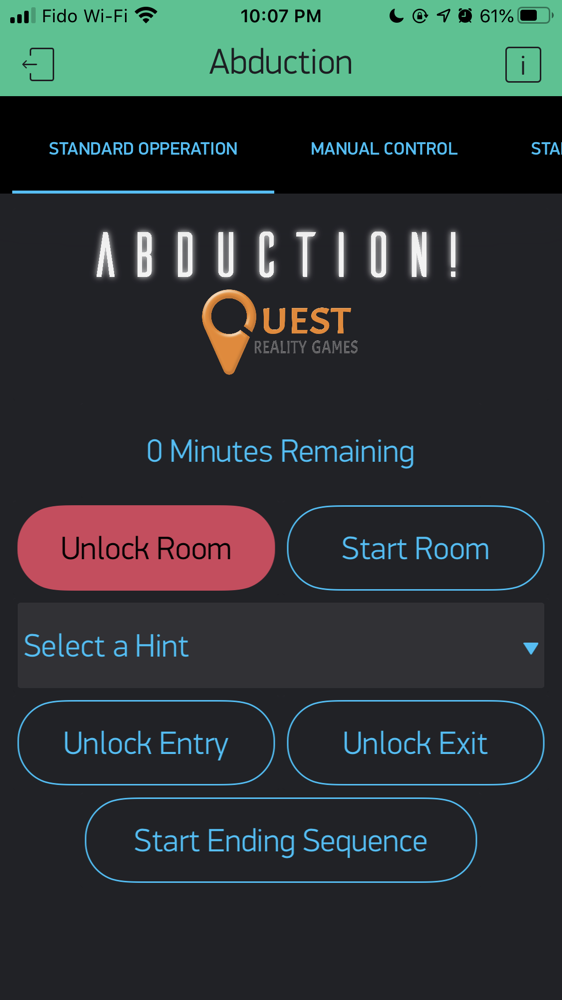
As the game is largely software-based, resetting the game back to zero is a simple process that requires a few steps. The game masters have to replace a few key items that are easy to remember and locate. Once the items are in place, they press the RESET button on the game remote, which returns the game back to the idle mode awaiting the start command. Doors and puzzles can be locked/unlocked with a few taps from the remote and an active status is displayed on the remote so the game masters know if many of the puzzles are in the correct state.
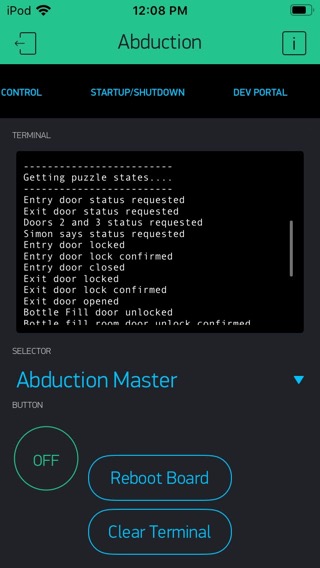
Once the game has been reset and the new players loaded, the game runs a pre-start check to ensure that all doors are locked, all puzzles are in the correct state etc before allowing the game to be started. If any of the pre-start conditions are not met, the game masters are notified and a list of what needs to be corrected is provided. This ensures that the experience is consistent for every player group.
Although a more widespread practice among escape rooms, the need for an immersive, story-driven narrative is key to an optimal experience for players. Before loading players into the game, they are given a briefing on the experience and how they ended up in the situation. Once inside, the game is started by a character coming over the “radio” (a series of speakers placed throughout the room) and kicks off the experience any providing some background and creating a dramatic effect. This was accomplished by hiring a voice actor, specifically sourced due to their credentials in the video game industry, to provide the basis for the character.
Throughout the game, the character returns to add to the story and continue to keep the players immersed in the experience.
Another key component to the dynamic elements of the game is the time-based progress of the experience. As the players progress through the game, there are processes going on behind the scenes that change how the game is played over time. For example, if the players arrive at a specific puzzle 15 minutes into the experience, the combination to solve a puzzle will be different compared to a group arriving at the same puzzle 45 minutes into the experience. The dynamic element of the game allows players to have differing experiences from one another, despite the fact that the core gameplay is the same.
This process is also woven into the story to create a seamless experience for the players while preventing the game from appearing static and linear.
As the experience was created from the ground up, the game also included puzzles made with custom designed and manufactured parts. With a background in parts design and manufacturing, we leveraged Encompass Co-Founder, Stuart Bryson’s, expertise to design, develop, and install all of the various physical components.
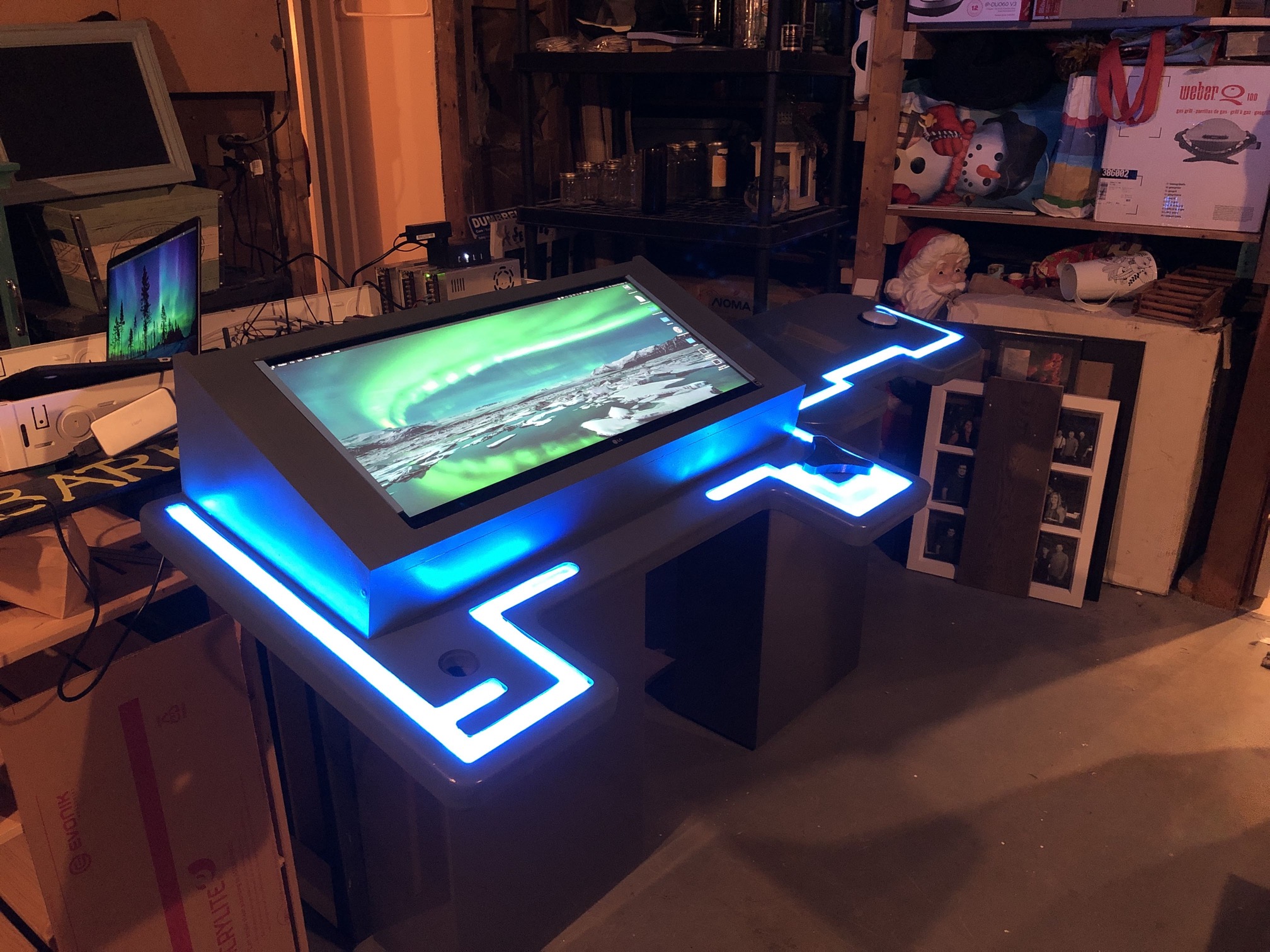
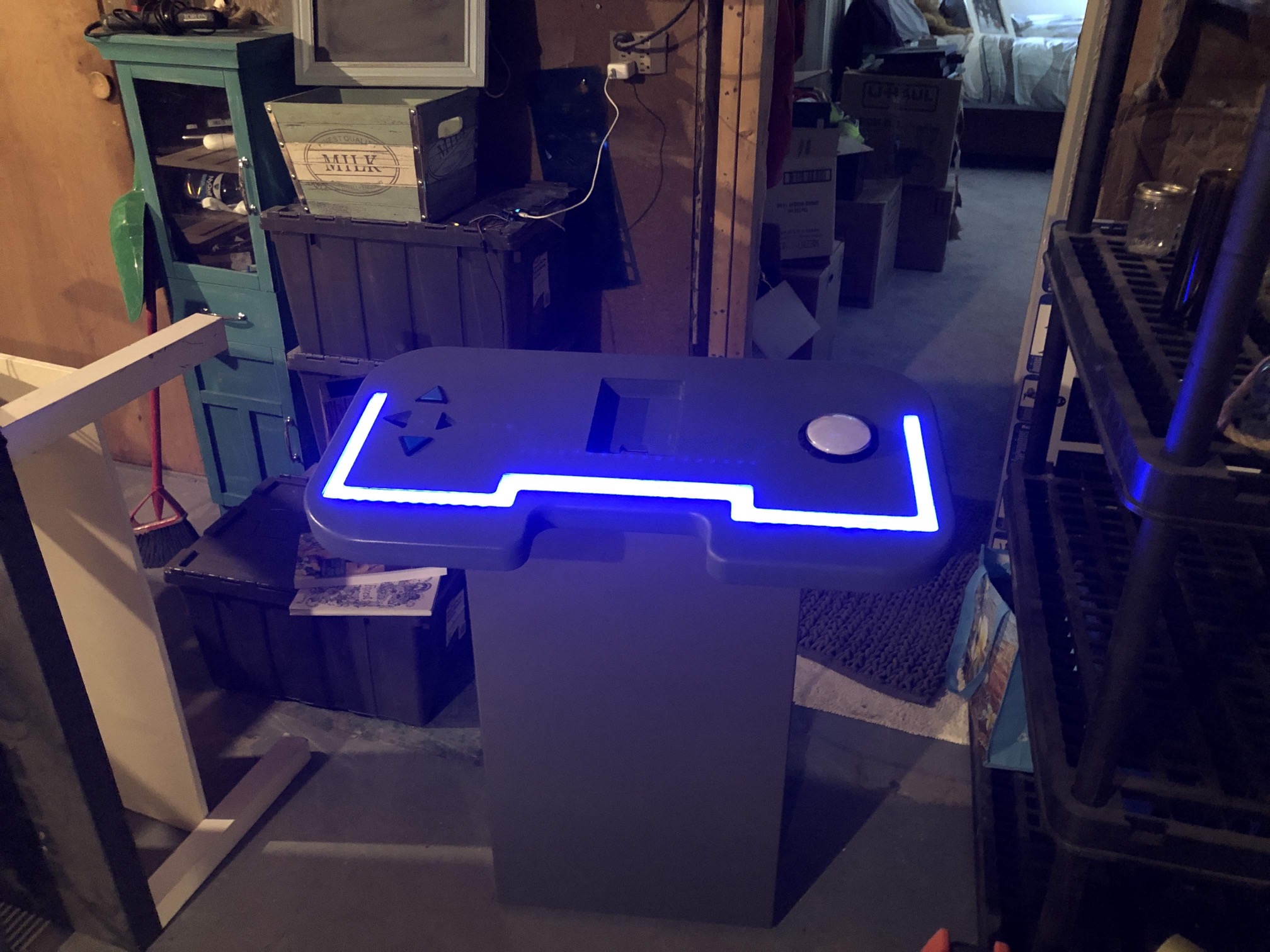
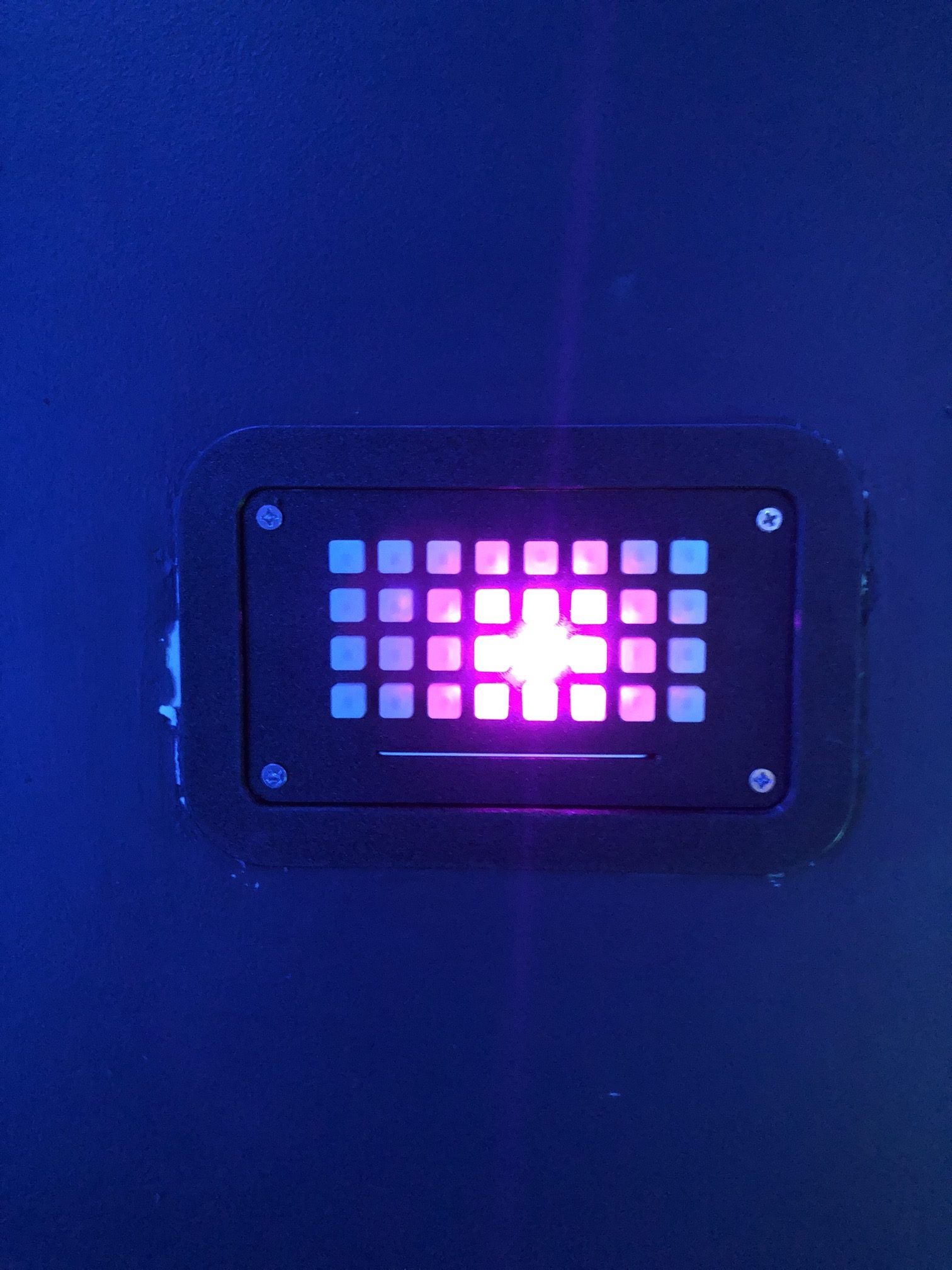
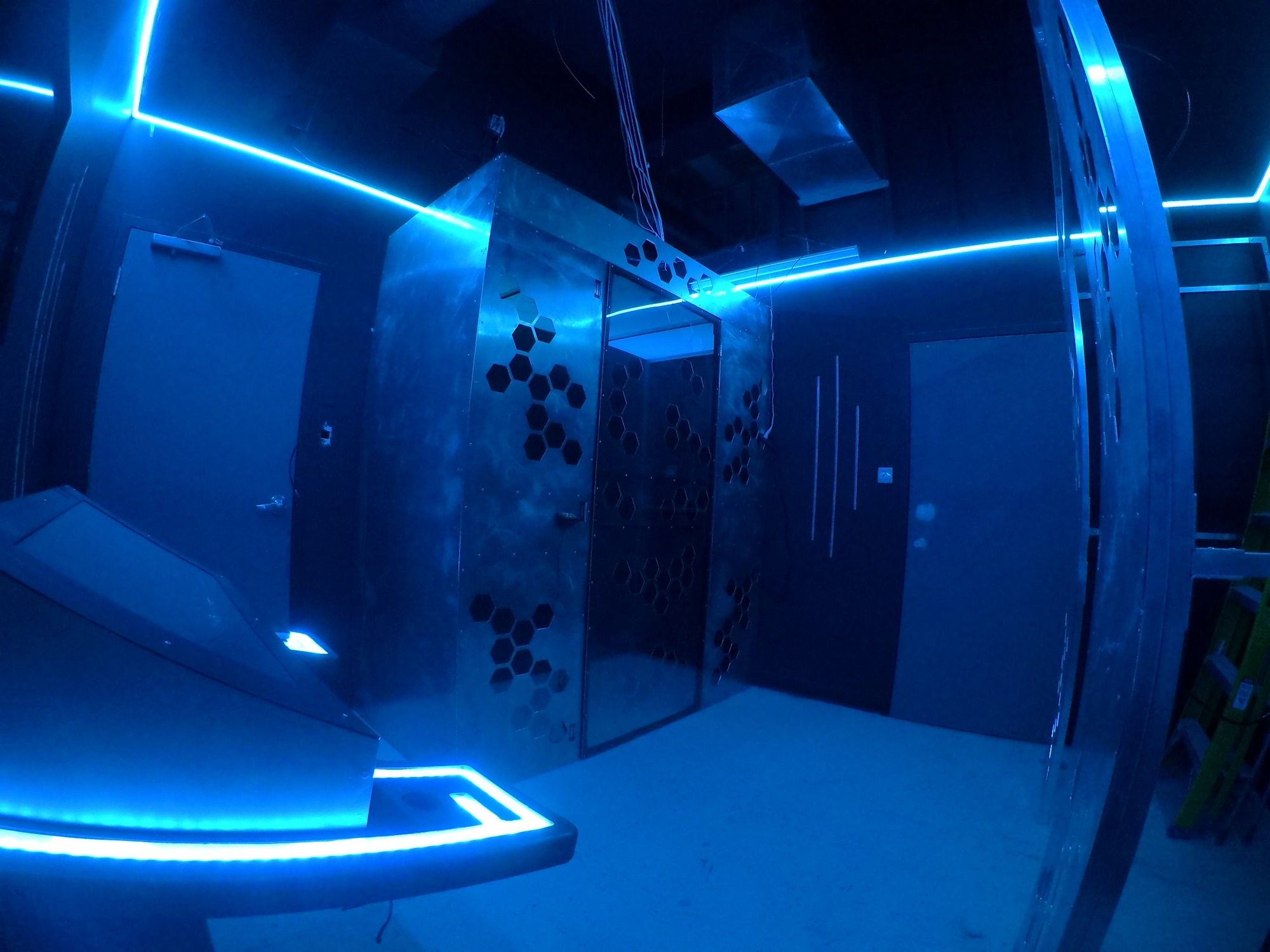
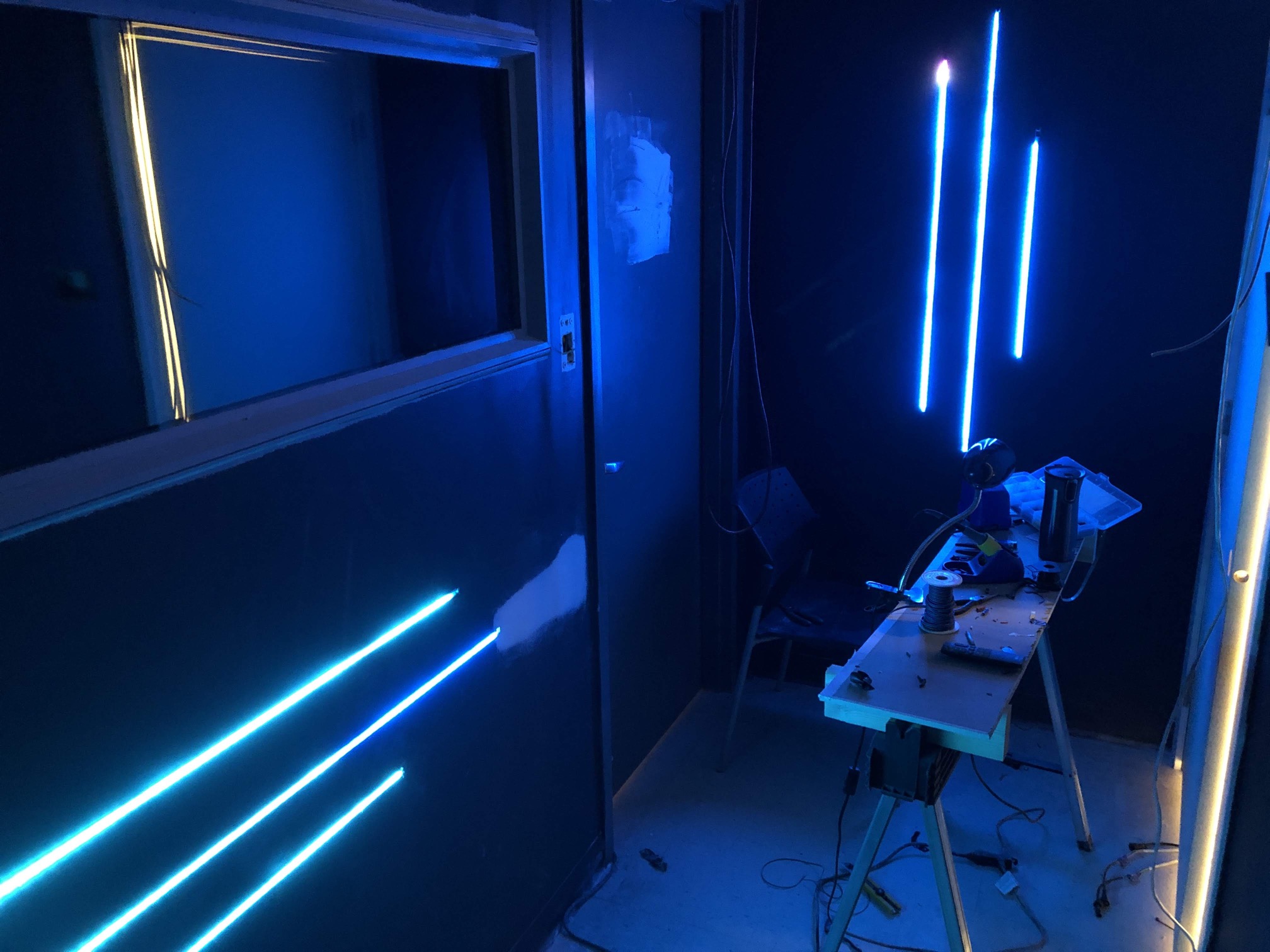
This included custom lighting fixtures, control panels, touch screen enclosures, and entire puzzles. The parts were made out of MDF, 3D-printed plastic, and aluminum. We acquired a 3D printer for the project and all of the physical components were assembled onsite by Encompass.
Each part was designed to fit the aesthetic of the room and also be relatively easily replaceable in the event of failure or damage.
Lighting, sound, and visual effects are arguably the most important elements in creating a compelling experience. The room is filled with ambient lighting that changes depending on triggers provided by the game. Lighting effects are also used as part of gameplay and incorporated into puzzles.
Screens and projectors also provide the visual elements which incorporate information required to solve puzzles as well as aesthetic appeal. Speakers placed throughout the various rooms in the experience evenly distributed sound effects, and cinematic animations and interactive elements were fired at various points through the game.
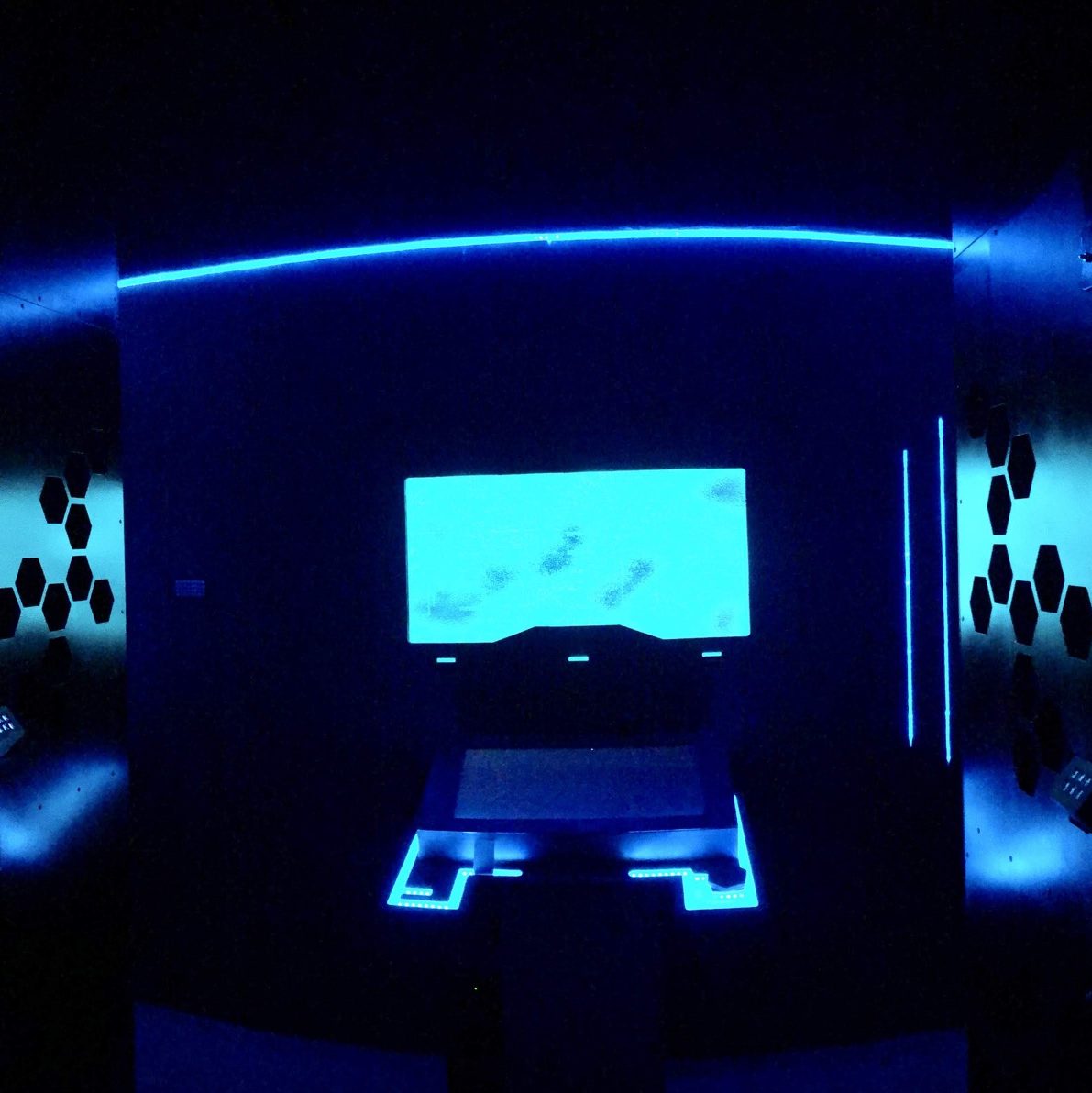
This was arguably the most enjoyable part of developing the experience and has received the most amount of positive feedback from players.
Overall, the Abduction! escape room experience was a challenging and extremely rewarding project that spanned several months of design, planning, storytelling, programming, and installation. It was arguably the most complex project that Encompass has undertaken, and the most challenging project I’ve managed and been involved in during my career. It incorporated every single aspect of my skillset from:
Abduction! is located at Quest Reality Games
1211 Wharf St, Victoria BC V8W 1T9
250-800-1008
To check out Abduction! for yourself, click here
